Arrays in Data Structures Explained (Operations, Complexity & Real Use Cases)

An array is a data structure that stores elements in contiguous memory locations, allowing fast access using an index.

 If you understand arrays deeply, you unlock the foundation of almost every DSA problem.

A Simple Story Before We Start

You’re building a feature to display user transactions.

At first:

The code is simple. Just displaying a list.

So why is it slow?

Because internally, your program is managing data in a structure -and how that data is stored matters.

If operations are not efficient, performance breaks.

This is where understanding arrays becomes critical.

What is an Array?

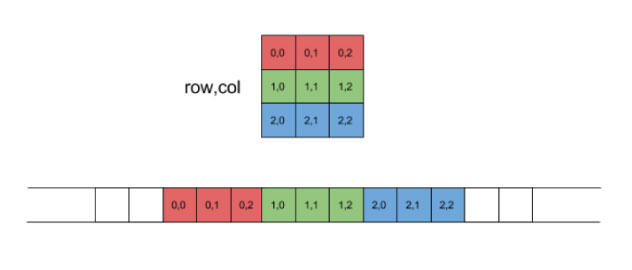
An array is a collection of elements stored in continuous memory locations.

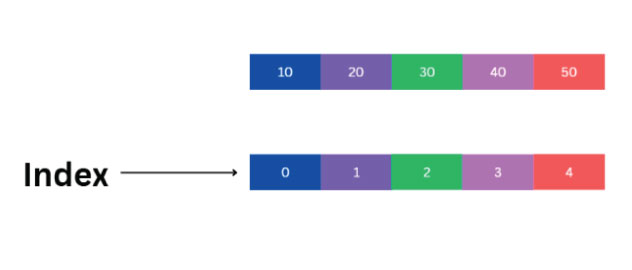
Each element is accessed using an index.

Example:

int[] arr = {10, 20, 30, 40};

Here:

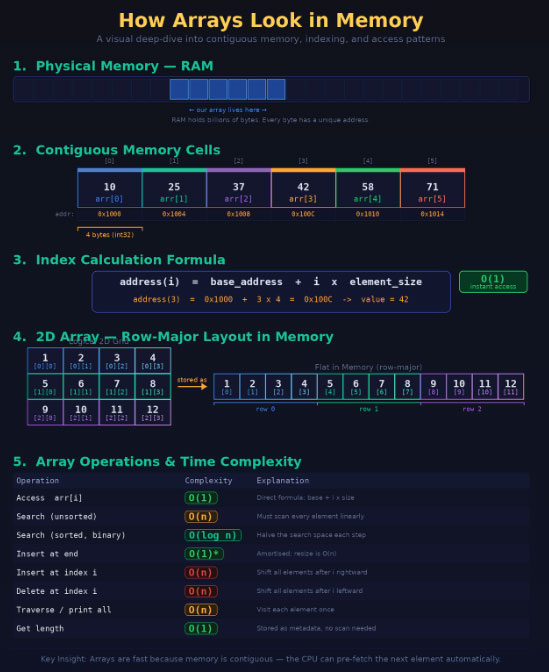
How Arrays Look in Memory

Arrays are stored side by side in memory.

Think of it like:

Index:   0   1   2   3
Value:  10  20  30  40

Because memory is continuous:

👉 The system can calculate the exact location instantly

That’s why array access is extremely fast.

Key Operations on Arrays

1. Access (Reading an Element)

int value = arr[2];

Time Complexity → O(1)

No matter the size, access is always instant.

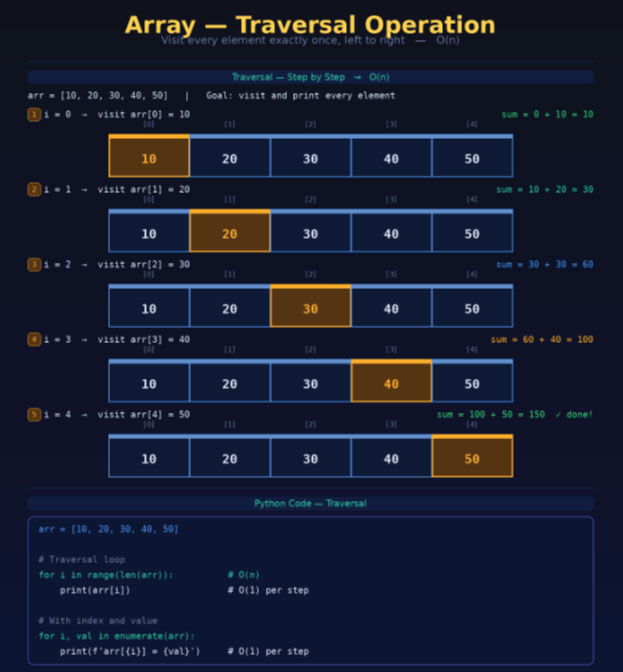
2. Traversal

for(int i = 0; i < arr.length; i++){
    System.out.println(arr[i]);
}

Time Complexity → O(n)

You visit each element once.
3. Insertion

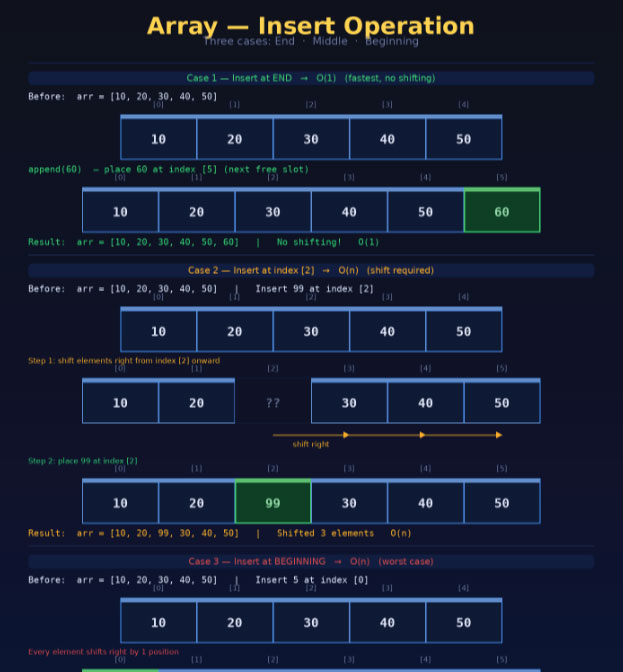
If inserting at the end:

arr[n] = 50;

Efficient if space is available.

But inserting in the middle:

[10, 20, 30, 40]
Insert 25 at index 1

Result:

[10, 25, 20, 30, 40]

All elements must shift.

Time Complexity → O(n)

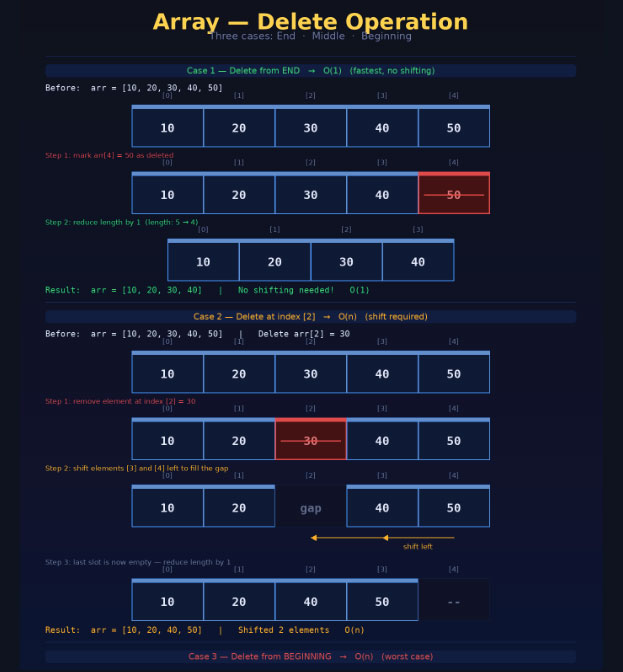
4. Deletion

Deleting an element also requires shifting.

Example:

[10, 20, 30, 40]
Delete 20
→ [10, 30, 40]

Time Complexity → O(n)

Visualizing Insert and Delete

Notice:

This is why arrays are not ideal for frequent modifications.

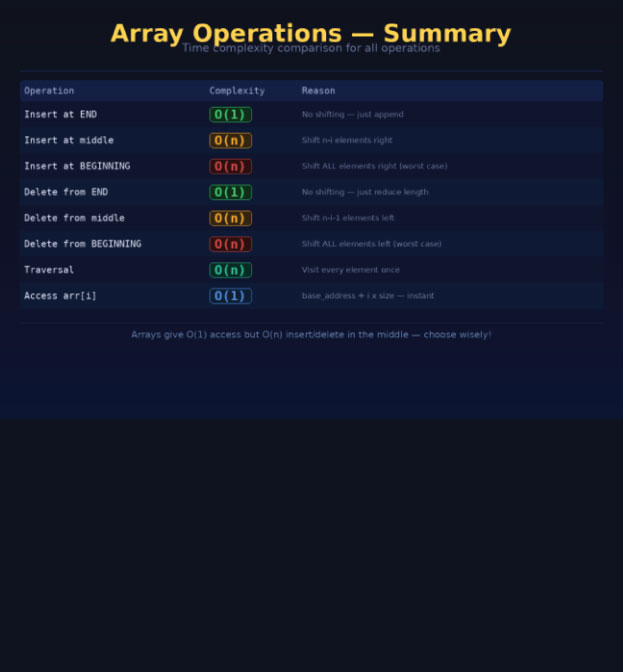
Time Complexity Summary

Operation

Time Complexity

Access

O(1)

Traversal

O(n)

Insertion

O(n)

Deletion

O(n)

Why Arrays Are So Powerful

Arrays are simple, but extremely powerful.

They are used in:

1. Databases

Records are stored and accessed using index-based structures.

2. Backend Systems

APIs return data as arrays (lists of users, products, etc.).

3. Frontend Applications

UI lists (feeds, tables) are arrays internally.

4. Algorithms

Most problems start with arrays:

Arrays are the entry point of algorithmic thinking.

Common Mistakes Beginners Make

1. Ignoring index boundaries

arr[5] // error if size is 5

2. Assuming insertion is always fast

It is only fast at the end, not in the middle.

3. Confusing arrays with dynamic structures

Arrays have a fixed size (in most languages like Java).

When NOT to Use Arrays

Arrays are not ideal when:

In such cases, structures like Linked Lists are better.

Real-World Insight

Arrays are fast because of:

But they are rigid because of:

This trade-off appears everywhere in system design.

Frequently Asked Questions (FAQ)

Are arrays fixed in size?

List) solve this limitation.

Why is array access O(1)?

Because memory location is calculated directly using index.

Are arrays used in real systems?

Yes. Almost every system uses arrays internally.

What is better: an array or linked list?

Depends on use case:

  • Fast access → array
  • frequent insert/delete → linked list

Final Thoughts

Arrays are the first step into real problem-solving.

They may look simple, but they teach you:

Most advanced problems are built on top of arrays.

If you master arrays, you build a strong foundation for everything that comes next.

What’s Next

Now that you understand how data is stored efficiently, the next step is learning how to 

Start your DSA journey with expert mentorship

Scroll to Top