By Manaswini De • Software Engineer & Instructor at CodeKerdos
“Programs must be written for people to read, and only incidentally for machines to execute.”
– Harold Abelson, Structure and Interpretation of Computer Programs
The Class Nobody Wants to Touch
Every developer, at some point, has stared at a class and felt that quiet dread settle in. Not because the code is obviously wrong – it might even be fully tested. Not because it crashes. It just feels dangerous. You want to change one small thing, but you have no idea what else you might break.
That feeling has a name: poor maintainability. And it is one of the most expensive problems in software engineering, because it compounds quietly over months and years, slowing down every team that touches the codebase.
public class UserService {

    // 18 injected dependencies

    public User registerUser(...) {}  // persistence
    public User updateUser(...)   {}  // persistence
    public void deleteUser(...)   {}  // persistence
    public void sendWelcomeEmail() {}  // communication
    public void generateReport(...)  {}  // reporting
    public void validateUser(...)   {}  // validation
    public void exportUserData(...)  {}  // export / ETL
    public void syncWithCRM(...)    {}  // integration
    public void calculateDiscount()  {}  // pricing

    // ... 40 more methods
}
Nobody wants to modify this. Nobody fully understands it. Every change feels risky, every bug takes hours to trace. The strange thing is: this class may be passing all its tests. Yet experienced developers recognise it immediately as dangerous.
Maintainability is not determined by whether code works today. It is determined by how easily the code can be understood and modified tomorrow.
What Does 'Maintainable' Actually Mean?
The word maintainability gets used constantly in engineering conversations, but it’s rarely defined precisely. In practice, a maintainable class is one where:
- A new developer can understand its purpose in under five minutes
- Changes to one area of the system don't propagate unexpected ripples
- Bugs can be diagnosed by reading the class, not by running the debugger for hours
- New features can be added with confidence rather than anxiety
- Tests can be written without setting up a complex web of mocks and stubs
Notice that none of these are about elegance, cleverness, or design patterns. Maintainability is fundamentally about the experience of the next developer – including future you. It is an act of professional empathy.
The measure of good code is not how impressive it looks when you write it. It’s how quickly someone else can understand it, change it, and trust it – six months later.
Seven Characteristics of a Maintainable Class
Maintainable classes are rarely the result of a single good decision. They emerge from seven interconnected properties, each reinforcing the others. Let’s examine each in depth.
01. A Maintainable Class Has One Reason to Exist
The Single Responsibility Principle from SOLID is well-known. But its nuance is frequently missed. A class can appear to be about one thing – say, orders – while actually harbouring multiple distinct responsibilities.
// This looks cohesive - it's all about orders. But look closer.
public class OrderService {
    public void createOrder()        {}  // domain logic
    public void sendOrderEmail()     {}  // communication
    public void generateInvoicePdf() {}  // document generation
    public void uploadInvoiceToS3()  {}  // file storage
}
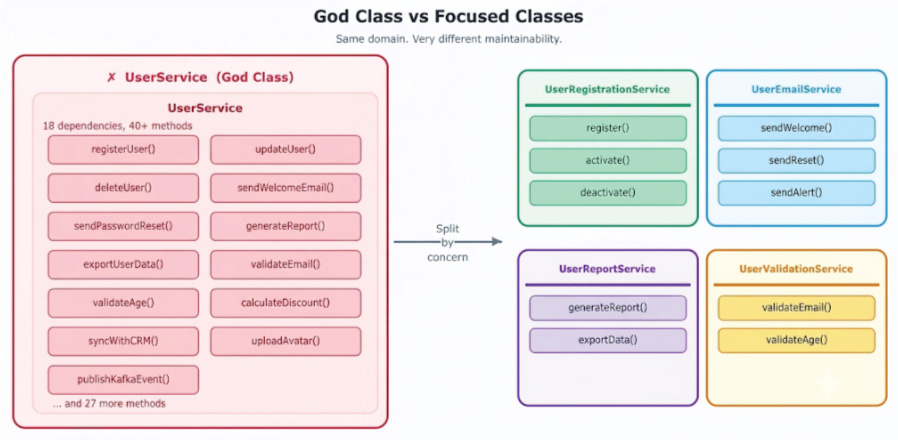
Each responsibility has its own team, its own change velocity, and its own bugs. When PDF generation changes (say, you switch libraries), it should have no risk of breaking email delivery. Bundling them together ensures every change carries unnecessary blast radius.
A useful self-test: can you describe this class in one clear sentence without using the word ‘and’? If your description naturally requires multiple ‘and’s, the class likely has more than one responsibility.
| ✗ Doing Too Much | ✓ Single Responsibility |
|---|---|
OrderService handles:
“Manages orders and emails and PDFs and uploads.” |
OrderCreationService
→ Creates and validates orders
OrderNotificationService
→ Email and SMS communications
InvoiceService
→ PDF generation + upload
|
02. A Maintainable Class Is Easy to Describe
The naming test is deceptively powerful. When a class becomes difficult to name – when you reach for words like Manager, Handler, Processor, Helper, or Utils – it is almost always because the class has accumulated responsibilities that don’t belong together.
// Clear name - clear purpose
class PriceCalculator { }
// Description: "Calculates product prices based on rules and discounts."

// Vague name - scattered purpose
class ProductManager { }
// Does it validate? Persist? Price? Notify? Manage inventory?
// You cannot know without reading every method.
Names are documentation. A class with a clear, specific name communicates its contract before the reader opens a single method. A vague name forces every reader to reconstruct the class’s purpose from scratch, every single time.
The Naming Smell Test: if you find yourself adding words like ‘Also’, ‘And’, ‘Plus’, or ‘Too’ when describing what a class does – it’s time to split.
Good names are narrow. Narrow names mean narrow responsibilities.
03. Dependency Count Is a Signal, Not Just a Number
The number of constructor dependencies is one of the most reliable early signals of a class’s health. Each dependency represents a collaboration – and each collaboration represents a responsibility the class is coordinating.
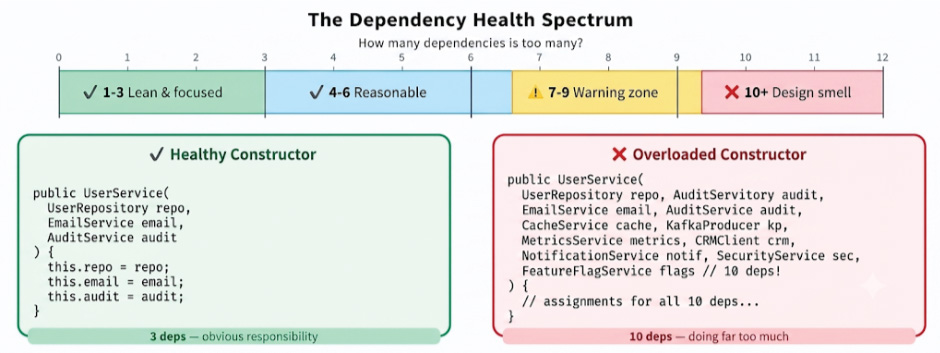
Three to five dependencies is usually a sign of a well-scoped class. When a constructor grows beyond seven or eight arguments, it is almost always because the class is doing too many things. The fix is rarely to reduce the dependencies; it is to split the class so that each resulting piece only needs the dependencies that actually serve its single purpose.
One practical heuristic: if your @Test setup requires more lines than the test itself – if you spend more time building mocks than asserting behaviour – your class under test is doing too much. The testing pain is a messenger, not the problem.
04.Cohesion Matters More Than Size
One of the most persistent misconceptions in software design is that class size is the primary quality metric. Lines of code is a blunt instrument. A 600-line class that does one thing well is healthier than a 150-line class that does five things poorly.
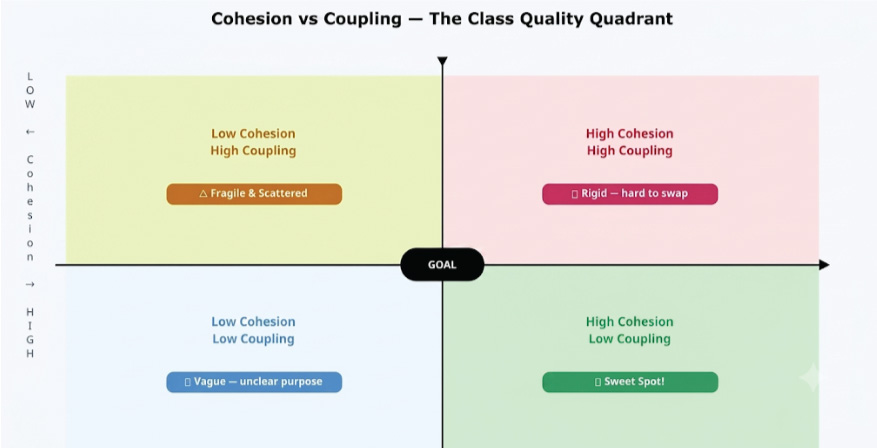
The quadrant above illustrates the real target: high cohesion combined with low coupling. High cohesion means every method and field inside the class contributes to the same goal. Low coupling means the class doesn’t have brittle dependencies on the internals of other classes. Together, they create a class that is easy to change in isolation.
Developers who aggressively split classes to reduce size often find themselves in the bottom-left quadrant – low coupling but low cohesion. The result is a proliferation of tiny classes with names like UserProcessor, UserHelper, and UserCoordinator, none of which has a clear reason to exist independently. The codebase grows larger while becoming harder to understand.
Don’t split because a class is large. Split because it has multiple distinct responsibilities. The right question is not ‘is this class too big?’ but ‘does this class try to do too many different things?’
05. A Maintainable Class Minimises Surprises
Predictability is the property that lets developers reason about code without executing it. When you read a method call, you should be able to form an accurate mental model of what it does – and your model should be correct.
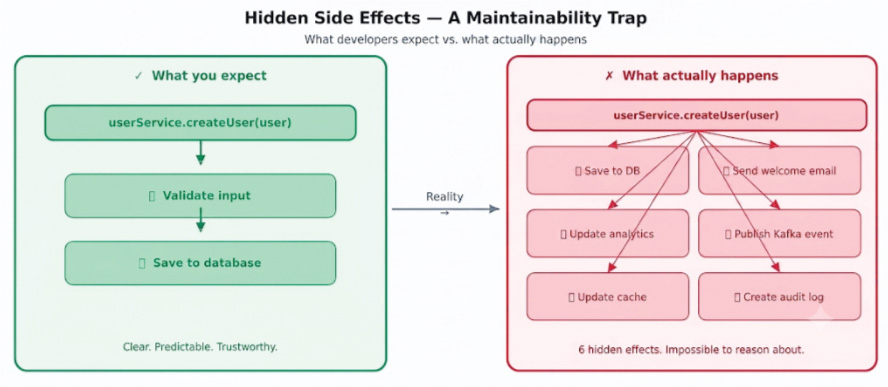
Consider userService.createUser(user). The name implies: validate the input, save the user. If that method also sends a welcome email, publishes a Kafka event, updates a cache, and writes an audit log – the developer calling it has no way to know that without reading its entire implementation.
This hidden complexity becomes a serious problem when the same method is called in a test, in a batch job, and in a registration flow – and all three contexts inadvertently trigger email sends and Kafka publishes they didn’t expect.
Side effects that must exist – like publishing an event when a user registers – belong in dedicated orchestration layers, not buried inside a service method. The Command pattern and Domain Events are two established ways to make these flows explicit rather than implicit.
06.A Maintainable Class Protects Its Invariants
Every class has invariants – rules about its state that must always be true. A BankAccount should never have a negative balance. An Order should never transition backwards through its status lifecycle. A User should never exist without a valid email address.
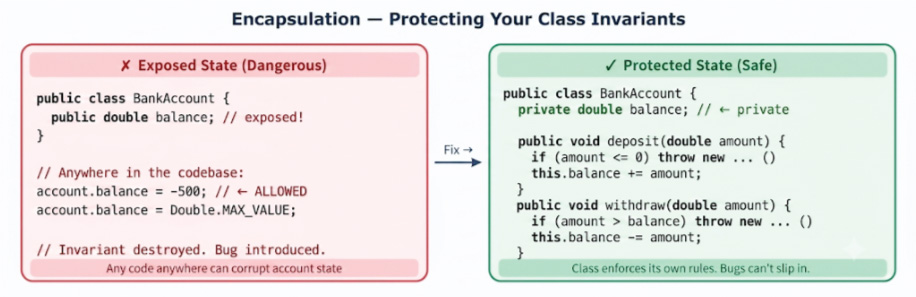
When a class exposes its internal state as public fields or provides unchecked setters, those invariants can be violated by any code anywhere in the system. The bug might be introduced weeks before it manifests, by a developer who had no idea the field had constraints.
// ✗ Broken: invariants exposed to the outside world
account.balance = -500;  // no error, silent corruption

// ✓ Protected: the class enforces its own rules
account.withdraw(500);   // throws InsufficientFundsException if violated
account.deposit(-100);   // throws IllegalArgumentException - amount must be positive

// The class is the authority on what constitutes valid state.
// No other class in the system can bypass these rules.
Strong encapsulation also simplifies debugging. When a bug involving a BankAccount appears, you know exactly where to look: the class itself. The invariants can only be violated through the class’s own methods, so the failure has a bounded surface area.
07. A Maintainable Class Is Easy to Test
Testability is not just a quality-assurance concern. It is a design feedback mechanism. A class that is hard to test is almost always hard to understand, hard to use, and hard to change. The test setup friction is the design problem made visible.
| ✗ Testing Pain = Design Pain | ✓ Clean Test = Clean Design |
|---|---|
|
To test one method, you need to mock: @Mock UserRepository @Mock EmailService @Mock CacheService @Mock KafkaProducer @Mock AuditService @Mock CRMClient @Mock MetricsService 7 mocks. The test setup is longer than the test. |
Focused class - testing is direct: @Mock UserRepository // one dep @Test void shouldRegisterUser() { when(repo.save(user)) .thenReturn(savedUser); var result = service.register(user); assertThat(result.id()).isNotNull(); } 1 mock. The test says exactly what it proves. |
When you find yourself dreading writing tests for a class – when the setup is more complex than the assertion – treat that as an immediate design review trigger. The correct response is not to skip the test; it is to fix the class.
The Seven Characteristics at a Glance
Here is a consolidated reference for all seven properties, with the early warning signs that indicate a class is drifting toward unmaintainability:
| # | Characteristic | What It Means | Warning Signs |
|---|---|---|---|
| 1 | Single Purpose | One reason to exist; one sentence description |
Method name has 'And', 'Or', 'Also' - multiple verbs |
| 2 | High Cohesion | Every method works toward the same goal | Features from different domains live in one class |
| 3 | Few Dependencies | 3–5 injected deps ideal; each dep = one responsibility |
Constructor takes 8+ args; hard to instantiate in tests |
| 4 | Predictability | Public methods do exactly what their name implies | Method does DB + email + cache + Kafka silently |
| 5 | Strong Encapsulation | State never directly exposed or mutated externally | Public mutable fields; setters that bypass rules |
| 6 | Easy to Test | One or two mocks max to test the core behaviour | Setting up 10 mocks just to call a single method |
| C | Descriptive Name | Name tells you what it does before you open the file | Names like Manager, Handler, Processor, Helper, Utils |
The Maintainability Scorecard
Use this scorecard as a practical lens during code review, refactoring planning, or when inheriting an unfamiliar codebase. It surfaces the dimensions most likely to cause long-term pain before that pain becomes load-bearing technical debt.
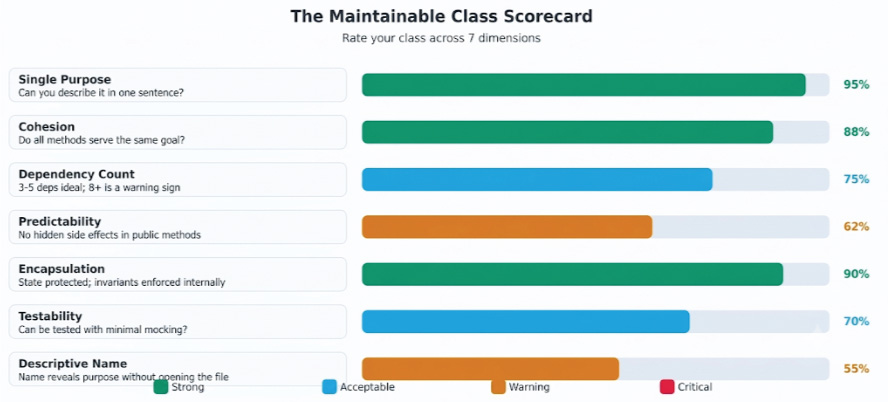
A class doesn’t need to score perfectly across every dimension. But any dimension in the red zone deserves immediate attention – because red-zone characteristics compound. A class with low cohesion tends to accumulate dependencies. High dependency counts tend to produce hidden side effects. Hidden side effects make encapsulation nearly impossible. The decay cascades.
A Note on Refactoring Toward Maintainability
Recognising an unmaintainable class is the easy part. Improving it in a live production codebase – without introducing regressions – requires discipline. Here is a sequence that works reliably:
- Characterise with tests first. Before touching the structure, write tests that document the current behaviour. These become your safety net.
- Identify responsibility seams. List every distinct concern the class handles. Each concern is a candidate for extraction.
- Extract one concern at a time. Move one responsibility into a new, well-named class. Run your tests. Commit. Repeat.
- Inject the extracted class. Replace the inline code with a dependency. Your original class becomes a thin coordinator.
- Observe the dependency list. As the original class sheds responsibilities, its dependency list should shrink. That shrinkage is the signal you’re on the right path.
Refactoring is not rewriting. It is moving behaviour without changing it.
The tests are your contract. If they all pass after each step, you are refactoring. If you find yourself updating test expectations, you are changing behaviour – and that’s a different (riskier) activity.
The Goal Is Not Small Classes
It is tempting to interpret all of the above as a mandate to aggressively split every large class into smaller pieces. Resist that temptation.
Developers who split too aggressively often end up with a forest of tiny classes – UserHelper, UserProcessor, UserManager, UserCoordinator, UserExecutor – each too small to understand on its own, none of which has a clear identity. The navigation becomes just as painful as the original God Class, just in the opposite direction.
// ✗ Over-split: now you have 5 classes with no clear identity
class UserHelper      { }  // what does 'help' mean?
class UserProcessor   { }  // what is being 'processed'?
class UserManager     { }  // what is being 'managed'?
class UserCoordinator { }  // what is being 'coordinated'?
class UserExecutor    { }  // what is being 'executed'?

// ✓ Right split: each class has a clear, nameable responsibility
class UserRegistrationService   { }  // handles signup and activation
class UserNotificationService   { }  // handles email and SMS
class UserAuditService          { }  // records state changes for compliance
The deciding factor is always clarity, not size. A 500-line class with a single clear responsibility is healthier than five 100-line classes whose responsibilities overlap and blur. The correct split is the one that produces classes you can name cleanly and reason about independently.
The Code Review Checklist
The next time you’re reviewing a class – yours or someone else’s – work through these questions:
Purpose
- Can I describe this class in one sentence without using 'and'?
- Is the name specific enough that I know what it does before reading the methods?
Cohesion
- Do all methods work toward the same goal?
- If I removed one feature, would the remaining class still make sense as a unit?
Dependencies
- Does the dependency list reflect a single, coherent responsibility?
- Could I explain why each dependency exists in one sentence?
Predictability
- Can I predict what each public method does from its name alone?
- Are there any side effects a caller might not expect?
Encapsulation
- Does the class protect its own state? Are there public mutable fields?
- Are business rules enforced inside the class, or scattered across callers?
Testability
- How many mocks does the test setup require? Is that proportional to the class's purpose?
- Do the tests test behaviour, or do they test implementation details?
Conclusion: Write Code for the Next Developer
The most maintainable classes are rarely the cleverest. They don’t rely on sophisticated design patterns to manage their complexity. They don’t require a PhD to understand. They simply do one thing, do it clearly, and make it impossible for the next developer to misuse them.
This is harder than it sounds. Writing clear, focused, well-named classes requires actively resisting the accumulation of responsibilities – saying no to the temptation to add just one more method, just one more dependency, just one more ‘while we’re in here’ change.
The technical term for what you’re building when you write a maintainable class is a low-cost future. Every hour you invest in clarity today saves hours of archaeology tomorrow – for a developer who might be you, six months from now, wondering what past-you was thinking.
Write for clarity. Design for the reader. Ship with confidence. 🚀