- Home /
- System Design /
- System Design Isn’t About Components – It’s About Making Trade-offs
System Design Isn’t About Components – It’s About Making Trade-offs
Introduction
Spend a few weeks studying System Design and you’ll start noticing a familiar cast of characters in every architecture diagram: Redis, Kafka, Load Balancers, API Gateways, CDNs, Read Replicas, Elasticsearch. They appear so reliably that you might start to think they’re the point – that good architecture is just knowing which of these boxes to place where.
That belief is understandable. It’s also one of the most limiting traps a developer can fall into.
“Every architectural component is an answer. The question is: do you know what question it’s answering?”
The moment you add Redis without being able to articulate which specific latency problem it’s solving – or choose Kafka without explaining what failure scenario it’s protecting against – you’re assembling a LEGO set, not designing a system.
This post is about the mental shift that separates engineers who pass System Design interviews from engineers who design systems that actually survive production. That shift is learning to think in trade-offs rather than technologies.
💡 The Core Insight
In engineering, almost nothing is free. Every improvement you make introduces a new cost somewhere else. Faster reads? You sacrifice storage. Higher availability? You sacrifice consistency. Lower latency? You sacrifice freshness. System Design is the art of choosing which costs are acceptable.
The Biggest Misconception About System Design
There’s a pattern that shows up constantly in system design preparation: people memorise architectures. Design Twitter? Kafka. Design WhatsApp? WebSockets. Design Netflix? CDN. Design Uber? Redis for geolocation.
This creates the illusion that experienced engineers have memorised hundreds of architecture blueprints and simply retrieve the right one on demand. They haven’t. What they’ve developed is something far more valuable: the ability to evaluate trade-offs clearly and communicate those evaluations confidently.
The architectures they produce are outputs of that thinking – not the thinking itself. When a senior engineer recommends Kafka, it’s because they’ve worked through the question of what happens when a downstream service is slow or unavailable, and they’ve decided that durable, asynchronous messaging is worth the operational overhead. Not because “Kafka = scalability.”
🚨 The Danger of Pattern Matching
Memorising architectures without understanding their trade-offs is like memorising chess openings without understanding positional play. It works – until your opponent makes an unexpected move. Design your systems for the actual problem in front of you, not the problem you’ve seen before.
The 9 Fundamental Trade-offs
Let’s walk through the core trade-offs that drive almost every architecture decision you’ll ever make. For each one, the goal isn’t to tell you which side to pick – it’s to help you understand what you’re gaining and what you’re giving up.
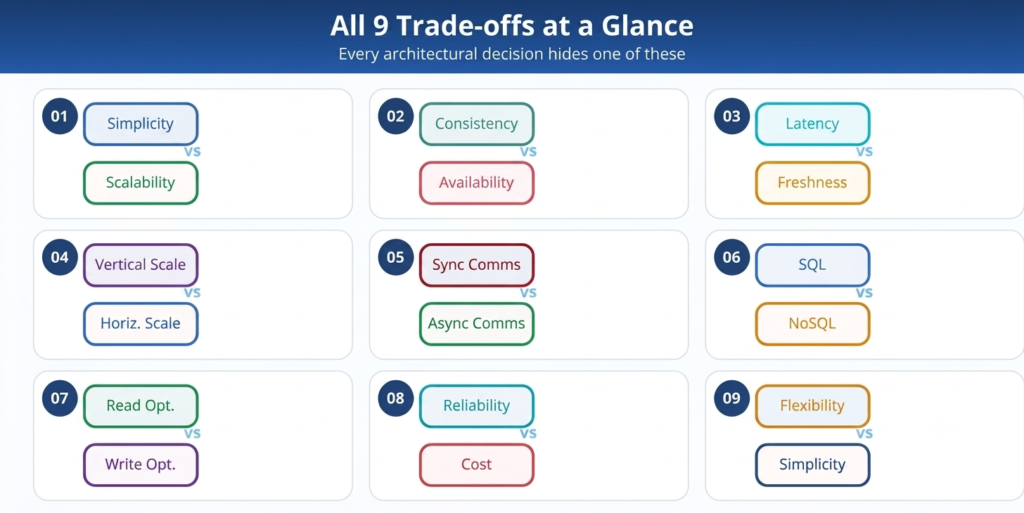
Figure 2: The 9 fundamental trade-offs – every architectural decision maps to at least one of these
#1
Simplicity
vs
Scalability
Imagine you’re building an e-commerce application for a college campus. You have 2,000 students and a weekend deadline. Would you immediately architect twenty microservices communicating over Kafka with five separate databases?
Of course not. A monolith would perform better, cost less, deploy in minutes, and debug in seconds. The complexity of microservices only pays off when the complexity of the monolith starts hurting you – when teams are stepping on each other’s deployments, when a single component needs to scale independently, when different services have genuinely different technology requirements.
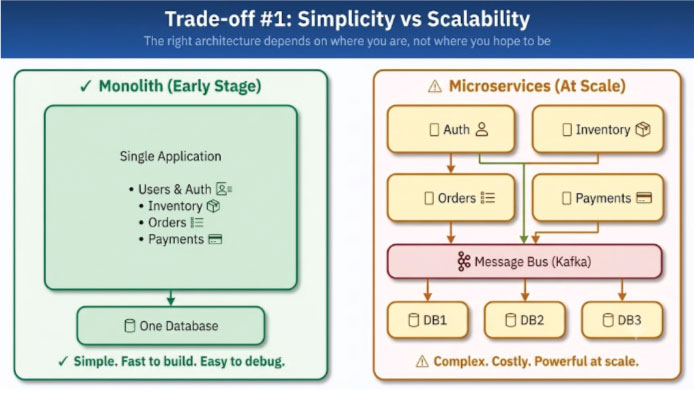
Figure 3: Monolith vs Microservices – both are right at different stages of growth
| Simplicity (Monolith) | Scalability (Microservices) |
|---|---|
| Easy to build and deploy | Complex to build and orchestrate |
| Trivial to debug locally | Hard to trace across services |
| Fast development cycles | Better team independence at scale |
| Low operational cost | High infrastructure overhead |
| Best for early stage | Best when constraints demand it |
The question is never “are microservices better?” It’s “when does the cost of microservices become worth paying?” That answer depends entirely on your team size, traffic, and deployment frequency.
💡 Engineer’s Rule
Start with the simplest architecture that could possibly work. Evolve toward complexity only when you have concrete evidence – not intuition – that simplicity is no longer serving you. Most systems never reach the scale that justifies microservices.
#2
Consistency
vs
Availability
Here’s a scenario: one concert ticket remains. Two users click “Buy” at the exact same millisecond on two different servers. Both servers read the inventory. Both see one ticket. Both proceed to sell it. You’ve just created a very unhappy duplicate booking.
This is the consistency-availability tension at its sharpest. The CAP theorem tells us mathematically that in the presence of a network partition, you must choose between consistency and availability – you cannot guarantee both simultaneously. But understanding the trade-off is more nuanced than the theorem suggests: different parts of the same application can make different choices.
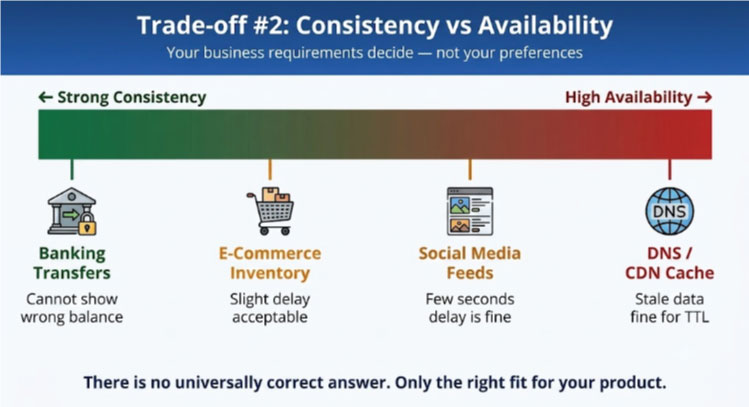
Figure 4: The Consistency–Availability spectrum – your product’s failure mode determines your position
A bank account balance demands strong consistency – showing a wrong balance, even for a millisecond, is catastrophic. An Instagram like counter can tolerate eventual consistency – if your post shows 1,203 likes instead of 1,204 for three seconds, nobody’s life is disrupted.
🧐 The Right Question
Before choosing a database or replication strategy, ask: “What is the worst thing that could happen if a user sees slightly stale data?” If the answer is “fraud, financial loss, or safety risk,” choose consistency. If the answer is “mildly inaccurate UI for a moment,” choose availability.
#3
Latency
vs
Freshness
Everyone wants fast applications. But fast and fresh are in constant tension. Fetching perfectly up-to-date data from a database on every request is expensive – in time, in compute, in database load. Caching solves the latency problem, but it introduces a new one: what you’re serving might not reflect the current state of the world.
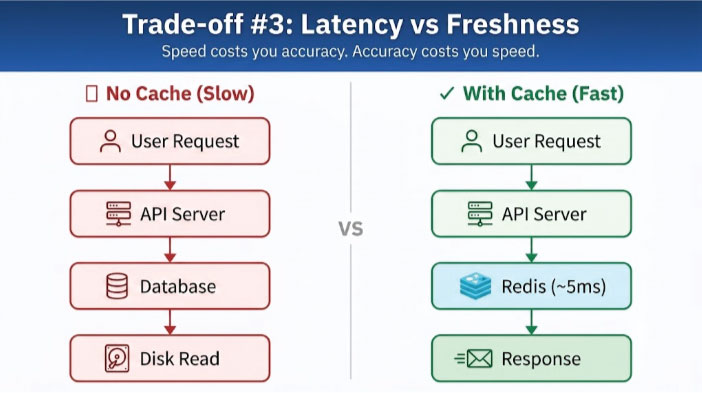
Figure 5: The caching trade-off – speed at the cost of data freshness
Amazon caches product descriptions because a product title changing three seconds after the actual update is far less damaging than adding 800ms to every page load. Instagram caches your feed because the cost of serving slightly stale content is negligible compared to the cost of regenerating your entire timeline on every request. But a stock trading platform cannot cache prices – a stale price can cause real financial harm.
Cache invalidation – knowing when to throw away stale cached data – is notoriously one of the hardest problems in computer science. TTLs (time-to-live settings), event-driven invalidation, cache-aside patterns, and write-through caches are all different strategies for managing this tension. Choosing between them is a trade-off decision, not a technical one.
💡 Cache Wisely
Not all data ages at the same rate. Cache aggressively what changes slowly (product descriptions, user profiles, configuration). Cache cautiously or not at all what changes rapidly (inventory counts, seat availability, live prices). Match your cache TTL to the cost of staleness for that specific data type.
#4
Vertical Scaling
vs
Horizontal Scaling
Your server is struggling. You have two paths forward. You can upgrade it – more CPU, more RAM, faster SSD. Or you can add more servers – distribute the load, introduce a load balancer, handle partial failures more gracefully.
Vertical scaling is seductive: it’s simple. No code changes. No architectural redesign. You just pay for a bigger machine. But it has a hard ceiling – there’s a maximum size server money can buy – and a single point of failure. If that one big machine goes down, everything goes down.
Horizontal scaling is more complex: your application needs to be stateless, your sessions need to be stored externally, your data needs to be partitioned. But it scales almost infinitely, and the failure of one node is absorbed by the rest of the fleet. Netflix doesn’t run on one very large server. It runs on tens of thousands of commodity machines, designed to tolerate individual failures gracefully.
💡 Design Principle
Vertical scaling is a short-term fix. Horizontal scaling is a long-term architecture. If you’re designing a system that you expect to grow significantly, design for horizontal scaling from the start – even if you start with a single node. It’s far harder to retrofit statelessness than to build it in.
#5
Vertical Scaling Synchronous
vs
Asynchronous
A customer places an order. Your system now needs to update inventory, send a confirmation email, notify the warehouse, generate an invoice, update analytics, and trigger a recommendation refresh. Should all of this happen before you return a response to the user?
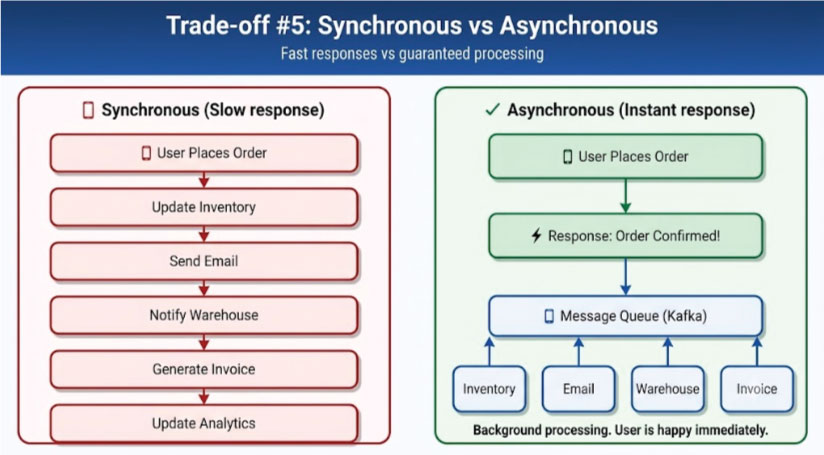
Figure 6: Synchronous vs asynchronous processing – responsiveness vs guaranteed completion
If yes, your user waits 3-4 seconds for an order confirmation while six separate operations complete sequentially. Many of those operations – sending an email, updating analytics – don’t need to happen before the user gets their confirmation. They just need to happen eventually.
Asynchronous processing via message queues (Kafka, RabbitMQ, SQS) allows the critical path – placing the order, charging the card, confirming availability – to complete immediately, while deferring everything else to background workers. The user sees a response in milliseconds. The rest of the work happens reliably in the background.
But asynchronous systems introduce their own complexity: you need to handle retries when workers fail, duplicates when messages are delivered more than once, and dead-letter queues for messages that repeatedly fail. You also lose the simplicity of a linear execution path – debugging across an async boundary is significantly harder.
#6
SQL
vs
NoSQL
Perhaps no question in system design interviews generates more confident wrong answers than “SQL or NoSQL?” Experienced engineers wince at this framing because it implies there’s a better option in the abstract. There isn’t.
SQL databases give you ACID transactions, strong consistency, structured joins, and decades of battle-tested reliability. They’re exceptional for financial systems, inventory management, anything where data relationships are complex and correctness is non-negotiable.
NoSQL databases make different trade-offs: flexible schemas, horizontal write scalability, and optimised access patterns for specific query shapes. DynamoDB can serve millions of reads per second at single-digit millisecond latency – but only if you model your data around its access patterns. Cassandra handles massive write throughput – but gives up rich querying capability.
🧐 The Better Question
Instead of asking “SQL or NoSQL?” ask: “What are my read patterns? What are my write patterns? Do I need transactions across multiple records? Can my schema evolve freely?” The answers point you to the right tool. The label “SQL” or “NoSQL” is a consequence of those answers, not a premise.
#7
Read Optimization
vs
Write Optimization
Understanding whether your system is read-heavy or write-heavy is one of the most underrated insights in system design. Two systems that look similar on the surface can demand radically different architectures based purely on their read/write ratio.
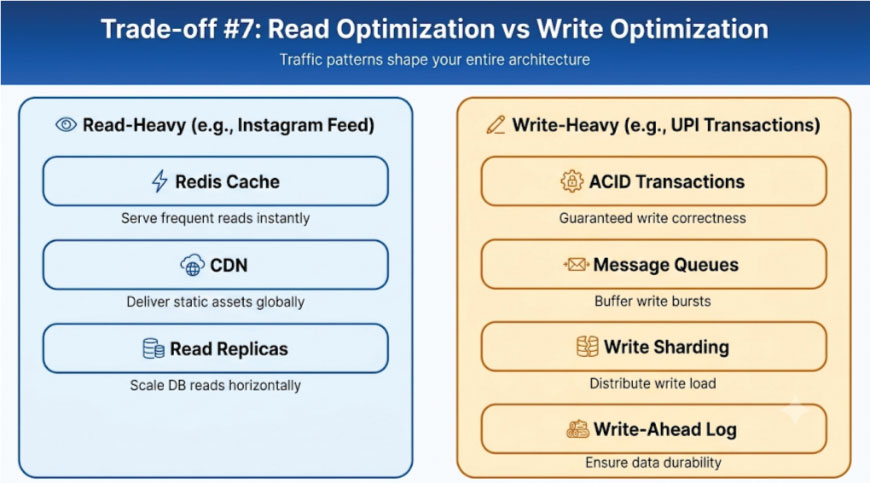
Figure 7: Read-heavy vs write-heavy systems demand completely different optimisation strategies
Instagram’s feed is read-heavy: millions of users constantly reading content that was written by a much smaller group. The architecture reflects this – aggressive caching, CDN delivery, read replicas, denormalised data structures optimised for feed assembly. The write path can be slower and more complex because it’s rarer.
UPI transactions are write-heavy at peak: during festival sales, tens of millions of payment attempts arrive within minutes. The architecture prioritises write throughput and durability above everything else – the read path (checking your balance) can tolerate a brief delay. Designing these two systems the same way would be a serious mistake.
#8
Reliability
vs
Cost
Every additional nine of availability you add to your system costs money. Not linearly – exponentially. Going from 99% to 99.9% uptime is relatively cheap. Going from 99.9% to 99.99% requires a fundamentally different architecture. Going from 99.99% to 99.999% – five nines, about five minutes of downtime per year – is extraordinarily expensive.
Multi-AZ deployments, database replication, hot standby servers, chaos engineering programs, redundant network paths – all of these increase reliability. They also increase your AWS bill, your operational complexity, and your on-call burden. A startup with 10,000 users does not need five-nine availability. A payment processor handling billions of transactions absolutely does.
💡 Right-size Your Reliability
Define your acceptable downtime first, then design to that SLA. Don’t architect for five nines because it sounds impressive. Architect for the reliability level your business actually needs and your customers actually expect. Over-engineering reliability is real, and it costs real money.
#9
Flexibility
vs
Complexity
There’s a particular kind of engineering trap called “speculative generality” – building abstractions, plugin systems, configuration layers, and generic APIs for requirements that don’t exist yet. The logic seems sound: “We might need this flexibility later.” The cost is immediate: the code becomes harder to understand today.
Every abstraction has a maintenance cost. Every layer of indirection adds cognitive overhead for every developer who touches that code. Sometimes that overhead is worth it – a well-designed plugin architecture can make extending a system trivially easy. But often, the flexibility is never used, and the abstraction simply makes the system harder to reason about.
Senior engineers are ruthless about this question: “will this flexibility actually be needed?” Not “could it possibly be needed?” but “do we have evidence that it will be needed?” YAGNI – You Aren’t Gonna Need It – is one of the most battle-hardened principles in software engineering, and it applies equally to architecture.
The Senior Engineer’s Mental Model
Before any technology choice is made, before any component is drawn, experienced engineers work through a set of questions that map the problem space. These questions aren’t a ritual – they’re a debugging process for your own assumptions.
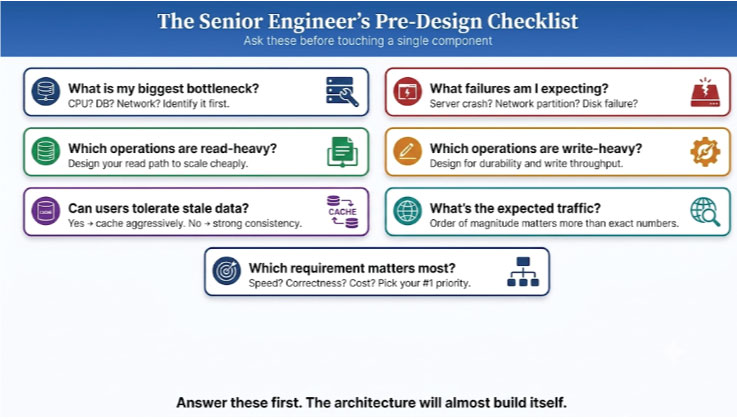
Figure 8: The pre-design checklist – answer these questions before touching a single component
Notice what’s absent from this checklist: no technology names. No “should I use Redis or Memcached?” No “Kafka or RabbitMQ?” Those questions come after the above ones are answered honestly. The technology choice is almost always obvious once the constraints are clear.
If you know your system is read-heavy with high tolerance for stale data, Redis caching is an obvious answer. If you know your system needs to decouple a slow downstream service from a fast critical path, a message queue is the obvious answer. The technology isn’t the insight – understanding the constraint is.
🏆 Interview Gold
In system design interviews, interviewers aren’t scoring you on whether you mentioned Kafka. They’re scoring you on whether you explained what problem Kafka solves in this specific system, why the trade-offs it introduces are acceptable here, and what alternative you considered and rejected. Lead with the problem. The technology follows.
Final Thoughts
System Design is not a vocabulary test. Knowing what Elasticsearch is doesn’t make you a system designer. Knowing that Elasticsearch trades write throughput and operational complexity for powerful full-text search – and knowing when that trade-off is worth making – does.
The engineers who design systems that scale, survive failures, and remain maintainable over years share a common habit: they are deeply comfortable sitting with trade-offs. They don’t look for the “correct” answer. They look for the “most defensible” answer given the constraints. And they can articulate exactly what they’re giving up to get what they need.
“Technologies are tools. Trade-offs are the material you’re actually working with. Master the trade-offs, and the right tool becomes obvious.”
The next time you see a beautifully drawn HLD diagram – with its Kafka queues, Redis caches, and load-balanced microservices – don’t admire the boxes. Ask what each one cost. What was sacrificed to place it there? What failure scenario was it designed to handle? What simpler thing was considered and rejected?
That’s what System Design has always been about. Not assembling components. Making thoughtful, honest, well-reasoned trade-offs.