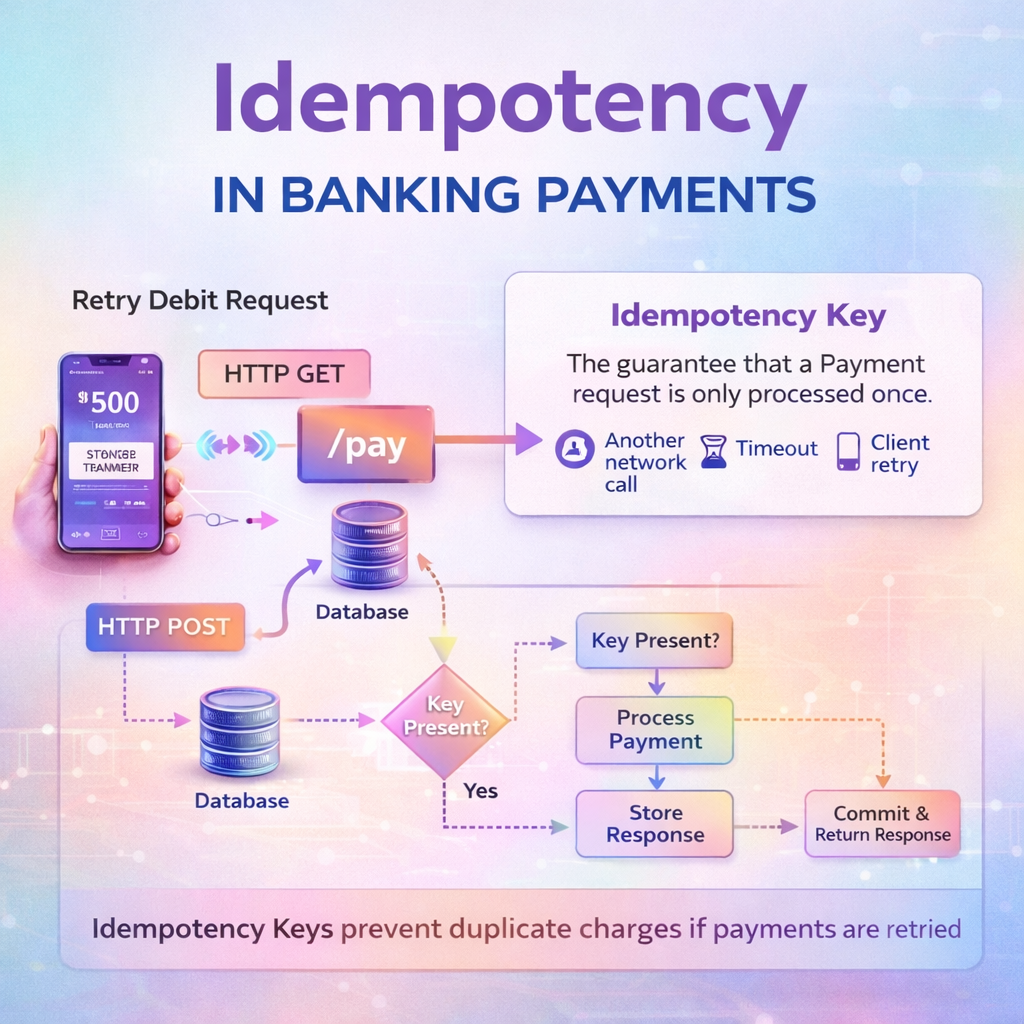
Introduction: One Request, One Result — Always
In banking and payment systems, the most dangerous bug is not a crash — it is a duplicate transaction.
Imagine this scenario:
- You click “Pay ₹5,000”
- Your screen freezes
- You refresh
- You click Pay again
Now ask the most important question:
Should ₹5,000 be debited once or twice?
If your system design is weak, the answer could be twice — and that is unacceptable in banking.
This is where Idempotency becomes one of the most critical concepts in system design, especially for banking, payments, and financial systems.
This blog explains idempotency from first principles, why it is mandatory in payments, how it works internally, and how real-world systems design it.
What Is Idempotency (In Simple Terms)
A system or operation is idempotent if:
Performing the same operation multiple times produces the same result as performing it once.
In payments, this means:
- Same request sent once → money debited once
- Same request sent twice → money still debited once
- Same request sent 10 times → still debited once
Idempotency is not a feature.
It is a guarantee.
Why Banking Systems Cannot Survive Without Idempotency
Banking systems operate in a distributed environment:
- Mobile apps
- APIs
- Payment gateways
- Core banking systems
- Network calls between services
Failures are normal:
- Network timeouts
- Client retries
- Server restarts
Without idempotency:
- Retries = duplicate debits
- Network glitches = financial loss
- User trust = destroyed
This is why every serious payment system is idempotent by design.
The Core Problem: Retries in Distributed Systems
In distributed systems:
- A request can succeed
- But the response may never reach the client
From the client’s perspective:
- “I don’t know if the payment went through”
So the client retries.
From the server’s perspective:
- It sees a brand-new request
- And processes it again
This mismatch is the root cause of duplicate payments.
What Goes Wrong Without Idempotency
Let’s look at a naive payment flow:
- Client sends payment request
- Server debits account
- Server sends success response
- Network fails before response reaches client
- Client retries request
- Server debits account again
This system is technically “working” — but financially broken.
Idempotency Key: The Backbone of Safe Payments
To fix this, payment systems introduce an Idempotency Key.
What Is an Idempotency Key?
An idempotency key is:
- A unique identifier generated by the client
- Attached to a payment request
- Used by the server to detect duplicates
Example:
Idempotency-Key: pay_8f9a23bc
High-Level Idempotent Payment Flow
Here is the correct system design flow:
Step-by-Step Flow
- Client generates a unique idempotency key
- Client sends payment request + key
- Server checks if key already exists
- If not:
- Process payment
- Store result against the key
- If yes:
- Return stored result
- Do NOT process payment again
This ensures exactly-once behavior.
Flow Chart (Textual Representation)
Client
  |
  |-- Payment Request (Idempotency Key)
  |
Server
  |
  |-- Check Key Exists?
        |
        |-- NO --> Process Payment --> Store Result --> Respond
        |
        |-- YES --> Fetch Stored Result --> Respond
This single check protects the entire banking system.
Where Idempotency Data Is Stored
Payment systems store idempotency records in:
- Databases
- Caches (Redis)
- Transaction logs
Each record includes:
- Idempotency key
- Request payload hash
- Payment status
- Response data
This allows safe replay of requests.
Handling Edge Cases (Real-World Complexity)
Case 1: Same Key, Different Payload
If:
- Same idempotency key
- Different amount or account
System must:
- Reject request
- Return error
This prevents abuse or bugs.
Case 2: Server Crash Mid-Transaction
If server crashes:
- Idempotency record already exists
- Retry fetches final state
System remains safe.
Idempotency vs Transactions
Idempotency is not the same as database transactions.
- Transactions protect data integrity inside a database
- Idempotency protects correctness across network retries
Payment systems need both.
Why Idempotency Is a System Design Problem
Idempotency cannot be solved by:
- Frontend alone
- Database alone
- API alone
It requires:
- API design
- Storage strategy
- Failure handling
- Retry strategy
This is why idempotency is a pure system design concern.
Real-World Examples
- Stripe requires idempotency keys for payments
- Razorpay enforces idempotent APIs
- UPI guarantees exactly-once debit
All serious payment systems follow this design.
Common Mistakes Developers Make
- Not using idempotency keys
- Using request timestamps as keys
- Not validating payload consistency
- Expiring keys too early
These mistakes lead to real money loss.
Key Takeaways
- Distributed systems fail — retries are normal
- Payments must be idempotent
- Idempotency keys ensure exactly-once behavior
- This is critical in banking systems
Final Thought
In payments:
Correctness is more important than speed.
Idempotency is not optional.
It is the difference between a system that works and a system that can be trusted.