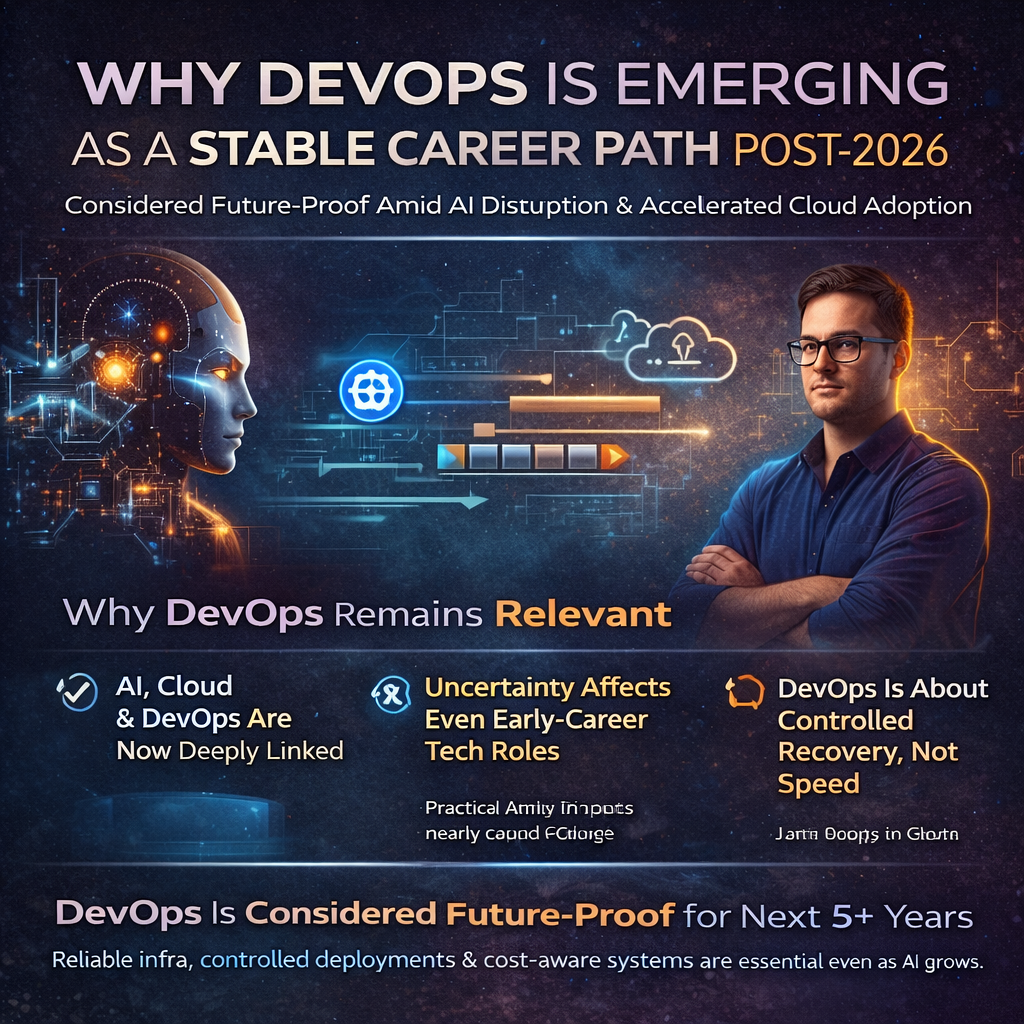
A Real-World Perspective from Industry Practice, Not Hype
In 2026, career uncertainty is no longer limited to senior professionals. Engineers with just 2–3 years of experience, professionals on the bench, and even those actively working in teams are asking the same question:
If I invest my time and energy into learning a new skill today, will it still matter five years from now?
DevOps is emerging as a strong answer to this question — not because it is trending, but because it sits at the core of how modern systems actually run.
This blog is based on real industry practices, instructor insights, and production-level thinking, not marketing promises.
How Technical Roles Quietly Lose Relevance Over Time
A decade ago, many IT roles felt stable:
- Manual server provisioning
- Patch management
- Environment setup
- Ticket-based operations
At that time, cloud platforms were immature, Kubernetes didn’t exist at scale, and infrastructure moved slowly.
Today, most of these tasks are:
- Automated by cloud platforms
- Abstracted by managed services
- Assisted or replaced by AI-driven tools
These roles didn’t disappear overnight — they simply stopped being central to business value.
This cycle continues with every major technology shift.
Why Even Early-Career Engineers Feel Pressure in 2026
Earlier, career anxiety was associated mainly with mid-career stagnation. In 2026, even engineers with 2–3 years of experience feel uncertain.
The reason is simple:
AI and automation have compressed timelines.
Setting up a basic CI/CD pipeline, provisioning cloud resources, or configuring environments is no longer a differentiator. AI tools can assist with these tasks quickly.
What AI cannot do reliably is:
- Own production failures
- Balance cost vs performance vs reliability
- Design recovery strategies
- Take responsibility when systems break
That responsibility still belongs to engineers — and increasingly, to DevOps engineers.
The 2026 AI Reset: Why Infrastructure Now Matters More
Industry leaders openly acknowledge that AI is no longer a feature — it is becoming infrastructure.
AI systems depend on:
- Reliable cloud platforms
- Kubernetes orchestration
- CI/CD pipelines
- Observability and monitoring
- Secure and cost-controlled environments
As AI-driven systems scale, failures become more expensive and visible. This makes infrastructure reliability and operational maturity non-negotiable.
DevOps sits exactly at this intersection.
Where Cloud, AI, and DevOps Converge
Modern systems are distributed by default. Whether serving users or running AI workloads, they rely on:
- Kubernetes for orchestration
- Infrastructure as Code for consistency
- Automated deployments for speed
- Monitoring and alerting for reliability
The real challenge is no longer how fast you deploy, but how calmly and safely you recover when something goes wrong.
A Real Production Scenario: Why DevOps Thinking Matters
Consider a common production situation:
A routine application update is deployed during peak traffic. The change is small — a new container image with updated configuration. Minutes later, latency increases. Pods begin restarting due to memory pressure.
Nothing is fully down, but user experience is degrading.
In a mature DevOps setup:
- Prometheus alerts trigger before customers complain
- The deployment is rolled back via GitOps using ArgoCD
- Kubernetes handles pod restarts automatically
- Traffic stabilizes without panic
The issue is fixed, limits are tuned, and the corrected version is redeployed.
No heroics. No chaos. Just controlled recovery.
This is real DevOps.
DevOps Is Not a Shortcut — It Is a Responsibility
DevOps is often misunderstood as a quick career escape.
In reality, DevOps engineers are expected to:
- Own production stability
- Reduce cloud costs
- Enable developers safely
- Design reliable pipelines
- Take accountability when systems fail
As automation increases, these responsibilities become more critical — not less.
That is why DevOps remains relevant across technology cycles.
Two Practical DevOps Career Paths in 2026
1. The Senior Pivot: Platform Ownership
For professionals with 8+ years of experience, DevOps often evolves into platform engineering.
Focus areas include:
- Kubernetes as a shared platform
- CI/CD and GitOps as internal products
- Standardized deployments using Helm
- Observability with Prometheus and Grafana
Here, DevOps becomes a long-term career anchor aligned with system design and reliability engineering.
2. The Fast-Track Transition: Regaining Market Relevance
For early-career professionals or those on the bench, the focus is proof of capability.
Key actions:
- Deploy real applications on EKS or similar platforms
- Automate infrastructure using Terraform
- Build CI/CD pipelines with rollback strategies
- Implement monitoring and alerting
The goal is not instant mastery, but visible system thinking.
Why DevOps Is Future-Proof for the Next 5 Years
Tools will change.
Platforms will evolve.
But these needs will not disappear:
- Reliable infrastructure
- Controlled deployments
- Cost awareness
- Security
- Observability
As AI accelerates development speed, operational complexity increases — making DevOps even more essential.
The Practical Next Step
If you feel uncertain about your career direction, start with a skills audit.
Compare your current skills against real DevOps expectations:
- Cloud fundamentals
- Kubernetes operations
- Infrastructure as Code
- GitOps workflows
- Monitoring and cost control
A structured learning path helps convert scattered knowledge into production-ready capability.
Final Perspective
Career stability in 2026 is not about chasing the newest tool.
It is about choosing a role that remains essential as technology evolves.
DevOps has survived multiple shifts — from on-prem to cloud, from monoliths to microservices, and now into AI-driven platforms.
For professionals navigating uncertainty, DevOps offers a long-term, responsibility-driven, and future-proof career path.