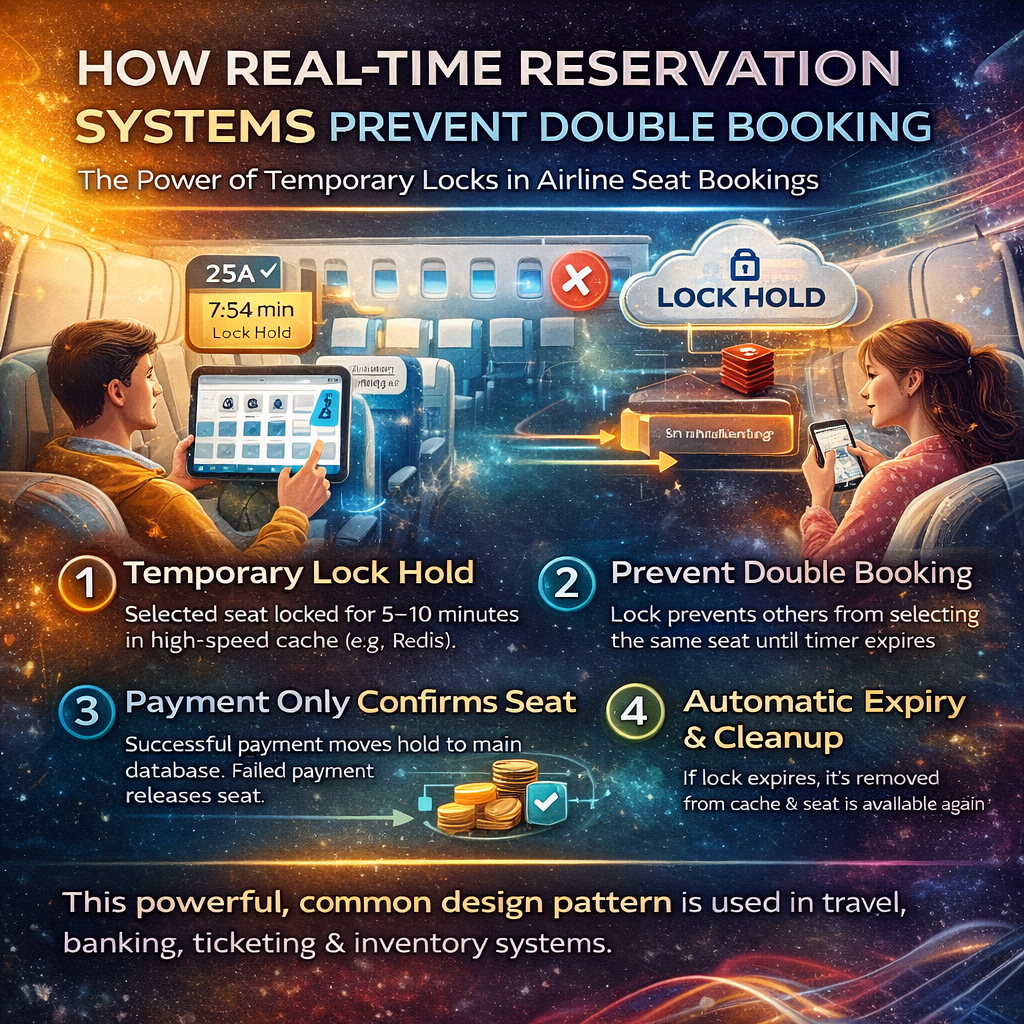
The Hidden System Design Behind Temporary Locks
Imagine this situation.
You are booking a flight ticket on an airline website. You select a seat, move to the payment page, and see a timer running — “Complete payment in 5 minutes.” During this time, no one else can book that same seat.
You haven’t paid yet.
The seat isn’t sold yet.
But it is not available to anyone else either.
This is not luck. This is not a simple database update.
This is a carefully designed real-time reservation system built to handle millions of users without conflicts.
In this blog, we’ll break down — step by step — how systems prevent double booking using temporary locks, explained in a way that anyone can understand.
The Core Problem: Why Double Booking Is Hard
At scale, booking systems face a brutal reality:
- Thousands of users click the same popular seat
- Requests hit servers at the same millisecond
- Databases are distributed, not single machines
A naive system would simply:
“Check if seat is available → Book it”
But this fails immediately under concurrency.
Two users can check availability at the same time and both see the seat as free.
Without protection, double booking is guaranteed.
Why Simple Database Checks Don’t Work
Many beginners think:
“Just put a unique constraint in the database.”
That helps, but it is not enough.
Why?
Because booking is not a single-step action. It involves:
- Seat selection
- Price calculation
- Payment gateway redirect
- Payment confirmation
This entire flow can take minutes.
The system must hold the seat temporarily while the user decides.
The Real-World Solution: Temporary Reservation Locks
Modern reservation systems use a two-phase approach:
- Temporary lock (soft reservation)
- Permanent booking (hard reservation)
This pattern is used by:
- Airline booking systems
- Hotel reservation platforms
- Event ticketing apps
- Appointment scheduling systems
Step 1: Seat Selection Triggers a Temporary Lock
When a user selects a seat:
- The frontend sends a request to the backend
- The backend checks availability
- If free, the system creates a temporary lock
This lock includes:
- Seat ID
- User/session ID
- Lock expiration time
The seat immediately becomes unavailable to others.
Step 2: Lock Is Time-Bound (Critical Detail)
Temporary locks are never permanent.
Each lock has:
- A strict TTL (Time To Live)
- Usually 3–10 minutes
If the user:
- Completes payment → lock is upgraded
- Cancels → lock is removed
- Closes app → lock expires automatically
This prevents seats from being blocked forever.
Step 3: Why In-Memory Stores Are Used
Temporary locks must be:
- Fast
- Distributed
- Automatically expiring
That’s why systems use:
- Redis
- Memcached
- In-memory key-value stores
Example conceptual lock key:
seat:{flight_id}:{seat_number} → locked_by_user_X (expires in 300s)
This avoids heavy database contention.
Step 4: Payment Happens Outside the Booking System
Payment gateways are external systems.
They can:
- Be slow
- Fail
- Timeout
- Retry callbacks
This is why the seat cannot be permanently booked before payment success.
The temporary lock safely holds the seat during this uncertain phase.
Step 5: Payment Success Converts Lock to Booking
Once payment is confirmed:
- Backend validates the lock
- Lock is converted to a permanent booking
- Seat status is written to the main database
- Lock is removed
Now the seat is officially sold.
Step 6: Handling Failures Gracefully
Good systems expect failure.
If payment fails or user abandons:
- Lock expires automatically
- Seat becomes available again
- No manual cleanup required
This is what keeps inventory flowing during peak traffic.
What Happens When Millions of Users Book at Once
High-demand events create extreme pressure:
- Flash sales
- Limited seats
- Massive concurrency
Systems handle this by:
- Rejecting new locks once inventory is exhausted
- Using atomic lock operations
- Rate-limiting abusive traffic
The goal is fairness and correctness, not speed alone.
Why This Is a System Design Pattern, Not a Trick
Temporary locking is not a hack.
It is a fundamental system design pattern used whenever:
- Resources are limited
- Actions are multi-step
- External systems are involved
This same idea appears in:
- Banking transactions
- Inventory management
- Distributed job scheduling
Key Design Principles at Play
Behind this simple user experience are deep principles:
- Concurrency control
- Time-bound state
- Failure tolerance
- Idempotent operations
- Separation of concerns
Users see a timer.
Engineers see a distributed state machine.
Final Thoughts
Great systems don’t rely on perfect users or perfect networks.
They assume:
- Users will abandon flows
- Networks will fail
- Traffic will spike
Temporary reservation locks allow systems to stay correct, fair, and scalable, even under extreme load.
Once you understand this pattern, you’ll start seeing it everywhere, from booking apps to payment systems.
That’s the beauty of system design hidden inside everyday apps.