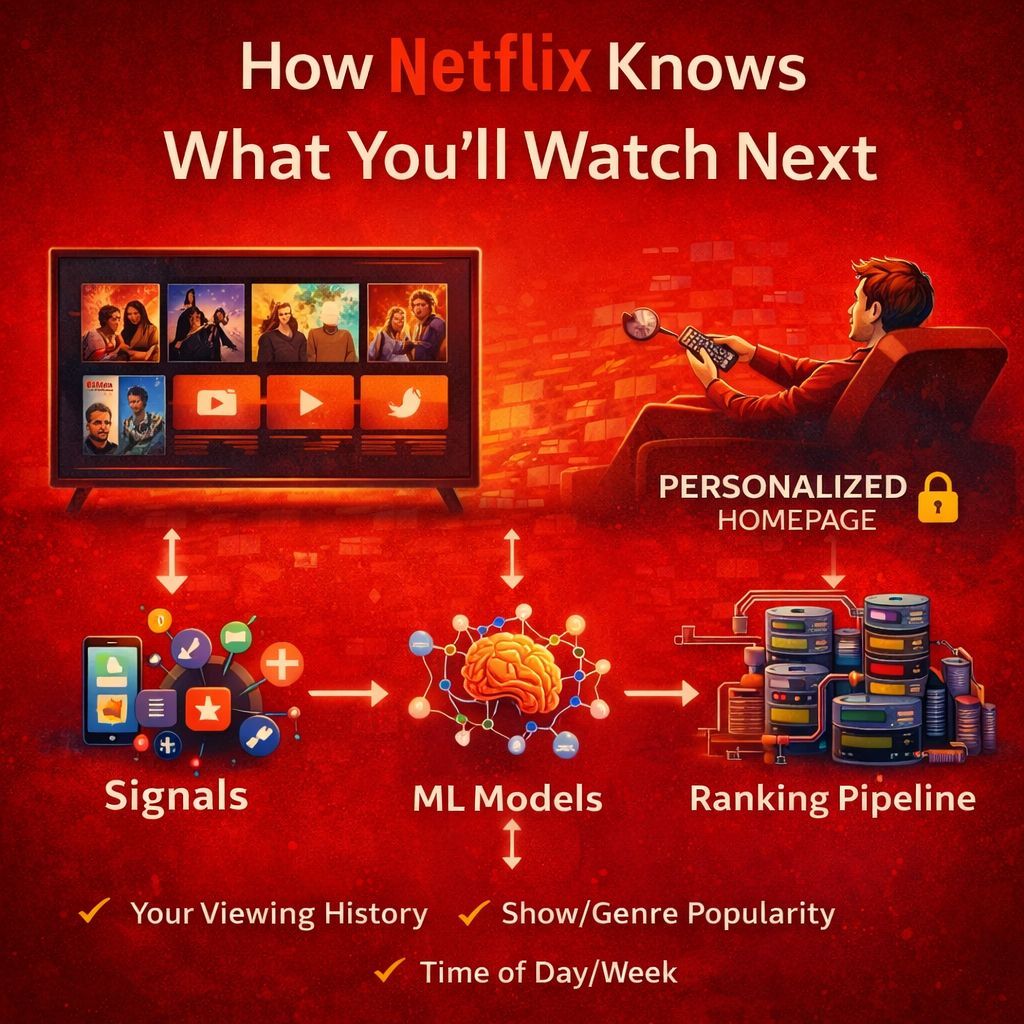
When you open Netflix, the homepage feels almost personal. The shows you see, their order, even the thumbnails — everything looks tailored just for you.
This is not magic.
It is the result of large-scale backend systems combined with machine learning, running continuously in the background.
In this blog, we’ll break down — in simple but detailed terms — what engineering actually powers Netflix-style recommendations, and why two users never see the same homepage.
1. The Core Problem Netflix Is Solving
Netflix has:
- Thousands of movies and shows
- Millions of users
- Limited screen space
The challenge is simple to state but hard to solve:
“What should we show THIS user, RIGHT NOW?”
If Netflix shows the wrong content:
- Users scroll less
- Watch time drops
- Subscriptions churn
So recommendation is not a feature — it’s the core business engine.
2. Why the Homepage Is Different for Everyone
Netflix does not have a single homepage.
Instead, every homepage is dynamically generated based on:
- User behavior
- Time
- Device
- Context
Two people opening Netflix at the same moment can see completely different screens.
This personalization happens in milliseconds.
3. Recommendation Signals: What Netflix Learns About You
Netflix does not rely on just one signal. It collects hundreds of small signals.
Explicit signals
- Likes / dislikes
- Ratings (earlier versions)
Implicit signals (more important)
- What you watch
- How long you watch
- What you stop midway
- What you rewatch
- What you search for
- Time of day
- Device type
Each action slightly updates your user profile.
4. From Raw Signals to User Profile
All user actions are sent as events to backend systems.
Flow:
- App sends events
- Events go to message queues
- Data is processed asynchronously
- User profile is updated
This allows Netflix to scale to millions of users without blocking the app.
5. Candidate Generation: Narrowing Down the Content
Netflix does not rank all content at once.
That would be too slow.
Instead, it first generates candidates:
- “These 500 titles might interest this user”
Candidate sources include:
- Similar users
- Similar content
- Trending content
- Recently released shows
This step is fast and backend-heavy.
6. Ranking vs Personalization (Very Important Difference)
Ranking
Ranking decides:
- Which items are more relevant
- In what order
It answers:
“Among these options, what should come first?”
Personalization
Personalization decides:
- Which items to even consider
- How the UI should be shaped
It answers:
“What even belongs on this user’s homepage?”
Netflix combines both.
7. Machine Learning’s Role
ML models:
- Score each candidate
- Predict likelihood of watch
- Estimate watch duration
But ML does not work alone.
Models need:
- Fresh data
- Fast serving systems
- Safe fallbacks
This is where backend engineering matters.
8. Why Thumbnails Also Change
Netflix experiments heavily with thumbnails.
Different users may see:
- Different images
- Different emphasis
Why?
Because visuals impact clicks.
This is powered by:
- A/B testing
- Experimentation platforms
- Real-time analytics
9. Backend Systems That Make This Possible
Behind recommendations are multiple systems:
- Event ingestion pipelines
- Feature stores
- Model serving layers
- Caching systems
- Experiment frameworks
All of this must respond in milliseconds.
10. Why This Is Hard at Scale
Challenges include:
- Data freshness
- Cold start users
- Latency constraints
- Model drift
- Infrastructure cost
A wrong design choice can:
- Slow the homepage
- Increase infra cost
- Hurt user trust
11. Failure Handling and Fallbacks
What if ML fails?
Netflix falls back to:
- Popular content
- Editorial picks
- Regional trends
User should never see a broken homepage.
12. Interview Perspective
If asked:
“How does Netflix recommend content?”
Good answer includes:
- Signals
- Candidate generation
- Ranking
- Backend + ML separation
This shows system-level thinking.
Final Thoughts
Netflix recommendations are not just about algorithms.
They are about:
- Engineering scale
- Fast backend systems
- Smart ML integration
- Continuous experimentation
Understanding this helps you see how ML and backend engineering work together in real products.
Once you know this, Netflix will never feel random a