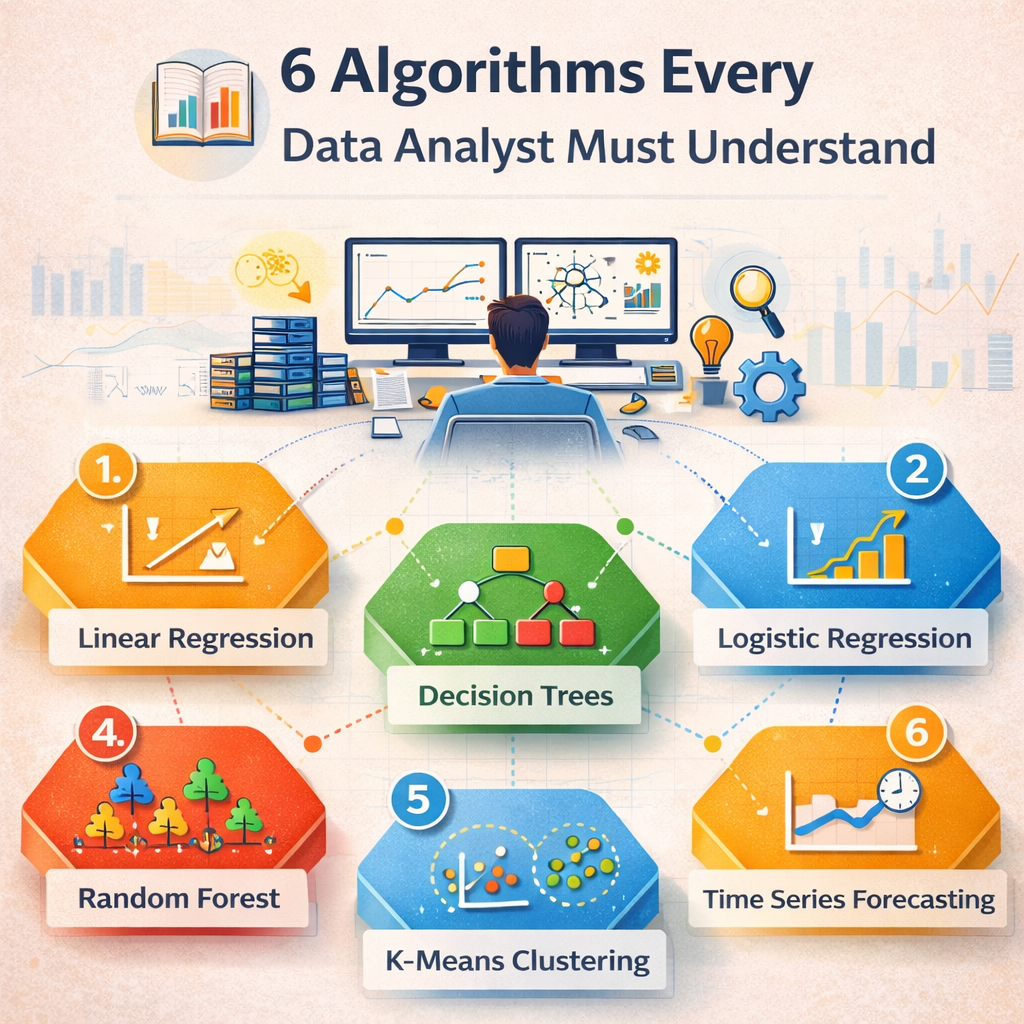
Becoming a good data analyst is not about knowing dozens of algorithms.
It’s about deeply understanding a small set of core algorithms that companies actually use to make decisions.
If you master the following 6 algorithms, you will be well‑prepared for:
- Real-world data analysis tasks
- Interviews
- Business problem solving
This blog explains what each algorithm does, when to use it, and why it matters in real industry scenarios — without unnecessary math.
1. Linear Regression
What problem does it solve?
Linear regression is used to predict a continuous value based on one or more input variables.
Examples of continuous values:
- Sales
- Revenue
- Price
- Demand
Simple intuition
It tries to draw the best-fit straight line that explains the relationship between inputs and output.
Real-world use case
- Predicting monthly sales based on past sales
- Estimating house prices based on size, location, and age
- Forecasting revenue using marketing spend
Why companies still use it
- Very fast
- Easy to explain to business teams
- Highly interpretable
Even when advanced models exist, companies often start with linear regression as a baseline model.
Common mistakes
- Using it when the relationship is not linear
- Ignoring outliers
- Overinterpreting predictions
2. Logistic Regression
What problem does it solve?
Logistic regression is used for binary classification — yes/no, true/false, 0/1 outcomes.
Simple intuition
Instead of predicting a number, it predicts the probability of an event happening.
Real-world use case
- Will a customer churn or not?
- Will a transaction be fraudulent?
- Will a user click an ad?
Why companies use it
- Probabilistic output
- Stable and reliable
- Easy to debug
It’s widely used in finance, marketing, and risk analysis.
Common mistakes
- Confusing it with linear regression
- Using it for multi-class problems without proper setup
3. Decision Trees
What problem does it solve?
Decision trees are used for both classification and regression problems.
Simple intuition
They work like a flowchart:
- Ask a question
- Split the data
- Repeat until a decision is made
Real-world use case
- Loan approval decisions
- Customer segmentation
- Rule-based recommendations
Why companies like decision trees
- Very interpretable
- Business-friendly
- Handles non-linear relationships
Limitations
- Overfitting on small datasets
- Sensitive to noisy data
4. Random Forest
What problem does it solve?
Random Forest improves decision trees by combining many trees.
Simple intuition
- Multiple trees make predictions
- Final result is based on majority voting or averaging
Real-world use case
- Fraud detection
- Credit scoring
- Customer churn prediction
Why companies trust it
- High accuracy
- Reduces overfitting
- Works well on messy real-world data
Trade-offs
- Less interpretable than a single tree
- Higher computational cost
5. K-Means Clustering
What problem does it solve?
K-Means is used for unsupervised learning — finding patterns without labels.
Simple intuition
- Group similar data points together
- Each group is called a cluster
Real-world use case
- Customer segmentation
- Market research
- Behavior analysis
Why analysts use it
- Simple
- Fast
- Easy to visualize
Limitations
- Need to choose K beforehand
- Sensitive to outliers
6. Time Series Forecasting
What problem does it solve?
Time series forecasting predicts future values based on time-based data.
Simple intuition
It looks at:
- Trends
- Seasonality
- Historical patterns
Real-world use case
- Stock price analysis
- Demand forecasting
- Website traffic prediction
Why it is critical
Many business decisions depend on future planning.
Common approaches
- Moving averages
- ARIMA
- Exponential smoothing
Final Thoughts
You don’t need to know every ML algorithm to be a great data analyst.
If you:
- Understand these 6 algorithms deeply
- Know when to use them
- Can explain them clearly
You are already ahead of most beginners.
Master the fundamentals first — advanced models can come later.