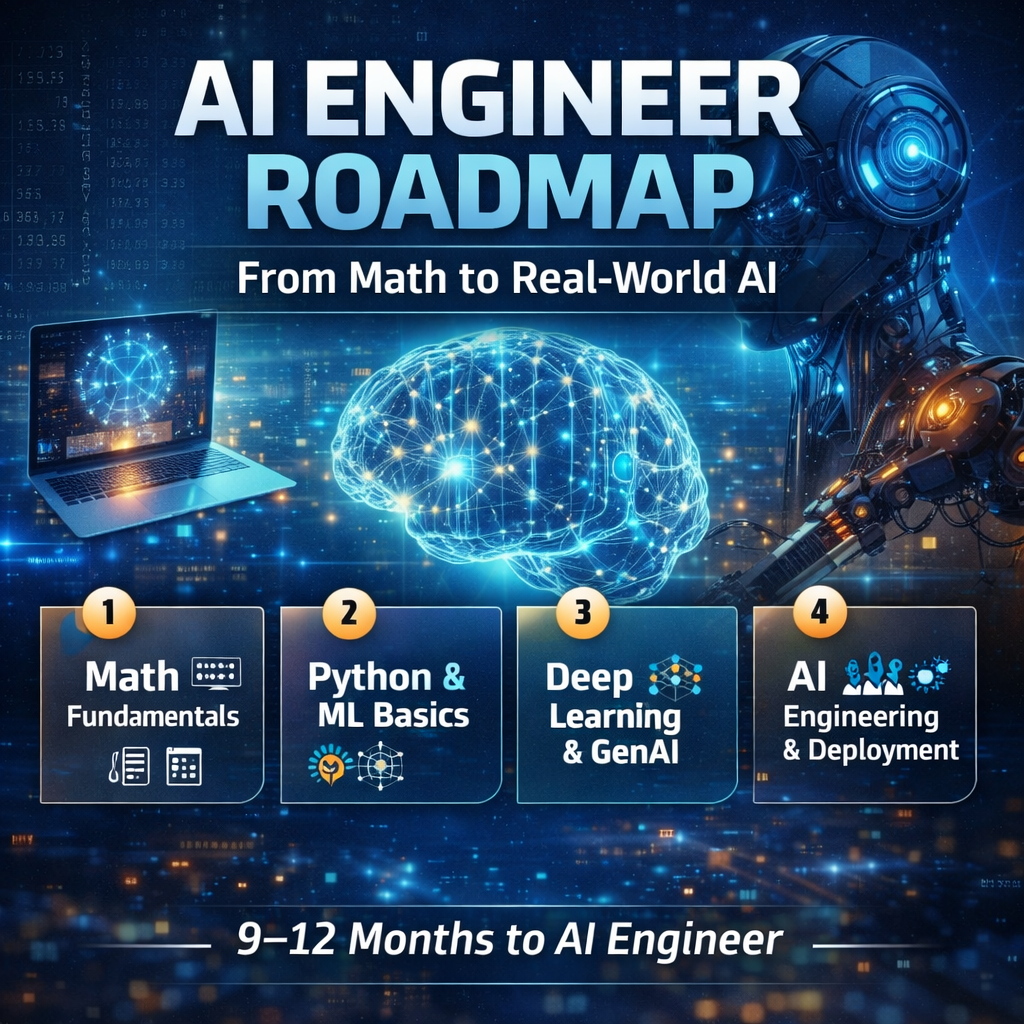
This roadmap is designed for someone who wants a clear, structured, and realistic path to become an AI Engineer — starting from math fundamentals and ending with real‑world AI systems.
No hype. No shortcuts. Just a step‑by‑step plan with timelines.
Who Is This Roadmap For?
- Beginners confused about where to start
- Developers transitioning into AI
- Students who want industry‑ready AI skills
- Anyone asking: “Kitne time me AI engineer ban sakta hoon?”
With focused effort, this roadmap can take 9–12 months.
Phase 0: Mindset & Reality Check (Week 0)
Before touching AI tools, understand this:
- AI engineers are problem solvers, not model runners
- Tools change fast, fundamentals don’t
- Math + logic + data thinking matter more than certificates
AI is not magic. It is applied mathematics + software engineering.
Phase 1: Mathematical Foundations (Month 1–2)
You don’t need PhD‑level math, but you must understand the basics deeply.
1. Linear Algebra (MOST IMPORTANT)
Focus on:
- Vectors & matrices
- Dot product
- Matrix multiplication
- Eigenvalues (conceptual)
Why?
ML models internally are matrix operations.
Tools:
- Khan Academy
- 3Blue1Brown (visual intuition)
2. Probability & Statistics
Learn:
- Mean, median, variance
- Probability distributions
- Bayes theorem (intuition)
- Standard deviation
Why?
ML = probability‑based predictions.
3. Basic Calculus (Selective)
Only focus on:
- Derivatives
- Gradient intuition
Why?
Training models = minimising loss using gradients.
Phase 2: Programming Foundation (Month 3)
Language Choice: Python (Mandatory)
Learn:
- Variables, loops, functions
- Lists, dictionaries
- OOP basics
- File handling
Why Python?
- Industry standard for AI
- Massive ecosystem
Data Handling Libraries
Must learn:
- NumPy (numerical computing)
- Pandas (data manipulation)
- Matplotlib / Seaborn (visualization)
Practice:
- Clean datasets
- Analyze trends
- Plot insights
Phase 3: Core Machine Learning (Month 4–5)
This is where actual ML starts.
ML Concepts
Learn:
- Supervised vs Unsupervised learning
- Regression vs Classification
- Bias‑variance tradeoff
- Overfitting & underfitting
Algorithms to Master
In this order:
- Linear Regression
- Logistic Regression
- Decision Trees
- Random Forest
- KNN
- K‑Means
Tools:
- Scikit‑learn
Goal:
Understand why an algorithm works, not just how to use it.
Phase 4: Deep Learning & Neural Networks (Month 6–7)
Now you move from ML to true AI systems.
Neural Network Basics
Learn:
- Neurons & layers
- Activation functions
- Loss functions
- Backpropagation (conceptual)
Frameworks
Choose ONE:
- TensorFlow
- PyTorch (preferred for research)
Build:
- Image classifier
- Digit recognizer
- Simple recommendation model
Phase 5: Specialised AI Domains (Month 8)
Choose at least ONE specialization:
1. Computer Vision
- CNNs
- Image classification
- Object detection
2. Natural Language Processing (NLP)
- Tokenization
- Embeddings
- Transformers
- Text classification
3. Generative AI (Hot Trend)
- LLM basics
- Prompt engineering
- Fine‑tuning
- RAG systems
Phase 6: AI Engineering (Month 9–10)
This is what separates learners from AI engineers.
Learn:
- Model deployment (FastAPI)
- Model versioning
- Inference optimization
- REST APIs for ML
- Cloud basics (AWS/GCP)
Build:
- End‑to‑end AI project
- API‑based ML service
Phase 7: Real‑World Projects & Portfolio (Month 11–12)
Projects matter more than certificates.
Build at least:
- 1 ML project
- 1 Deep Learning project
- 1 Production‑ready AI system
Examples:
- Resume screening AI
- Chatbot using LLMs
- Recommendation engine
- Image moderation system
Deploy them publicly.
Time Commitment Reality
- 2–3 hours/day → 12 months
- 4–5 hours/day → 9 months
Consistency > speed.
Common Mistakes to Avoid
- Jumping directly to GenAI tools
- Ignoring math
- Watching tutorials without building
- No deployment experience
Final Advice
AI engineering is not about learning everything.
It’s about learning the right things in the right order.
Follow this roadmap honestly, build real projects, and you can confidently call yourself an AI Engineer.