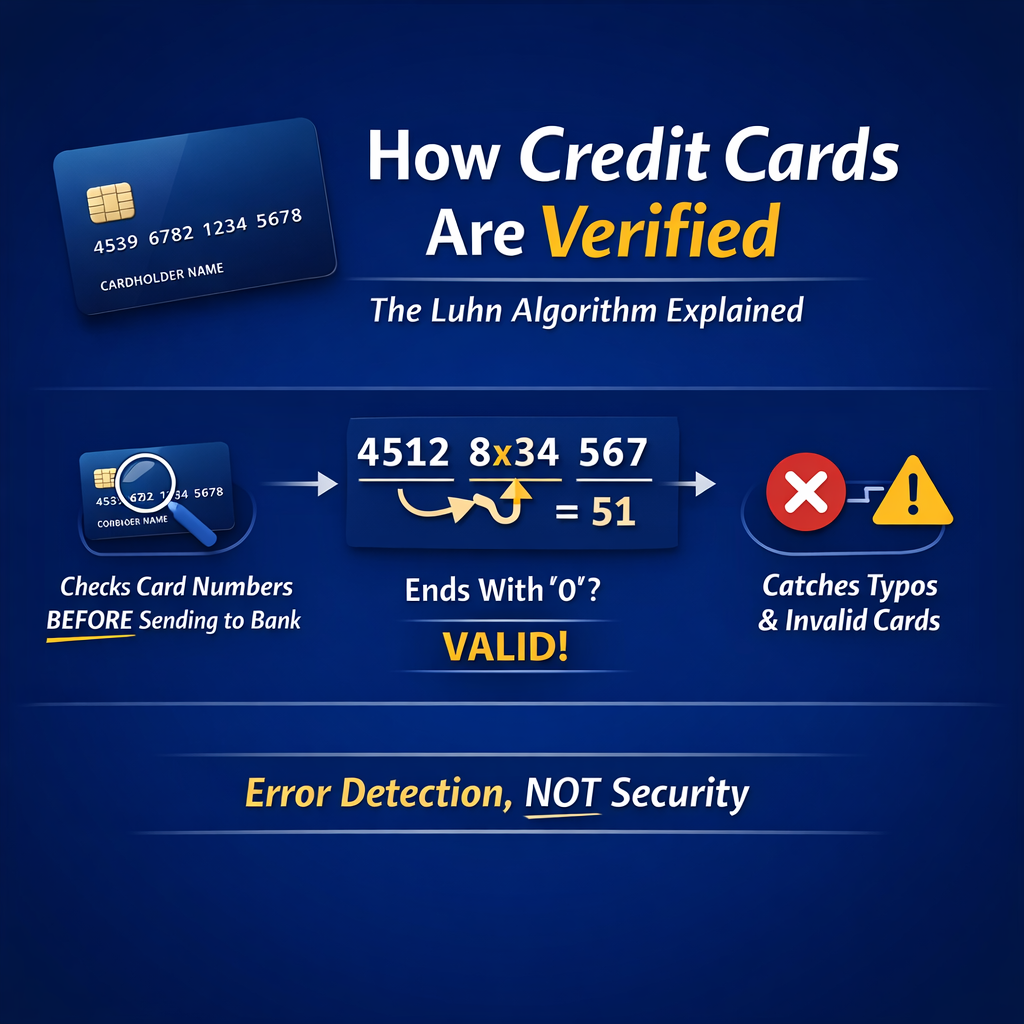
Introduction: Credit Card Validation Happens Before the Bank
When a user enters a credit card number and clicks Pay, the system does not immediately contact the bank.
Before any network call, payment gateway request, or banking verification happens, the card number goes through a basic but critical validation step.
This validation step is powered by the Luhn Algorithm.
The Luhn Algorithm helps systems quickly determine whether a credit card number is structurally valid or clearly incorrect due to typing errors.
This blog explains:
- Why credit card validation is needed
- What the Luhn Algorithm actually is
- How it works step by step with examples
- Where it fits in real payment systems
- What it can and cannot guarantee
Why Credit Card Numbers Need Validation
Credit card numbers are entered manually by users. This introduces common errors:
- Mistyped digits
- Swapped digits
- Missing digits
Sending invalid card numbers to banks would:
- Waste network calls
- Increase system load
- Create unnecessary payment failures
To prevent this, systems perform client-side and server-side validation before contacting payment networks.
The Luhn Algorithm exists to solve this exact problem.
What the Luhn Algorithm Is (And What It Is Not)
The Luhn Algorithm is:
- A checksum validation algorithm
- Designed to detect common input errors
- Lightweight and fast
The Luhn Algorithm is NOT:
- Encryption
- Fraud detection
- Security protection
Passing the Luhn check does not mean the card is real, active, or funded.
It only means the number is mathematically valid.
Where the Luhn Algorithm Is Used
The Luhn Algorithm is commonly used for:
- Credit cards
- Debit cards
- Payment tokens
- Identification numbers
Most payment forms run the Luhn check:
- In the browser
- On the backend
- At payment gateways
This ensures invalid card numbers are rejected early.
Structure of a Credit Card Number
A typical credit card number contains:
- Issuer Identification Number (IIN)
- Identifies Visa, Mastercard, Amex, etc.
- Account Number
- Identifies the cardholder account
- Check Digit
- The last digit
- Used by the Luhn Algorithm
The check digit exists solely for validation.
How the Luhn Algorithm Works (Step-by-Step)
Let’s walk through the algorithm using a real example.
Example Card Number
4539 1488 0343 6467
Step 1: Remove Spaces
4539148803436467
Step 2: Start From the Right (Excluding the Last Digit)
The last digit (7) is the check digit.
We process digits from right to left, skipping the check digit initially.
Step 3: Double Every Second Digit
Starting from the right (excluding the last digit), double every second digit:
| Position | Digit | Operation | Result |
|---|---|---|---|
| 1 | 6 | Double | 12 |
| 2 | 4 | Keep | 4 |
| 3 | 6 | Double | 12 |
| 4 | 4 | Keep | 4 |
| 5 | 3 | Double | 6 |
| 6 | 4 | Keep | 4 |
| 7 | 3 | Double | 6 |
| 8 | 0 | Keep | 0 |
| 9 | 8 | Double | 16 |
| 10 | 8 | Keep | 8 |
| 11 | 4 | Double | 8 |
| 12 | 1 | Keep | 1 |
| 13 | 9 | Double | 18 |
| 14 | 3 | Keep | 3 |
| 15 | 5 | Double | 10 |
Step 4: Subtract 9 From Results Greater Than 9
If doubling results in a number greater than 9, subtract 9:
| Result | Adjusted |
|---|---|
| 12 | 3 |
| 16 | 7 |
| 18 | 9 |
| 10 | 1 |
Step 5: Sum All Digits
Add all processed digits plus the check digit:
3 + 4 + 3 + 4 + 6 + 4 + 6 + 0 + 7 + 8 + 8 + 1 + 9 + 3 + 1 + 7 = 80
Step 6: Check Modulo 10
If the total sum is divisible by 10, the card number is valid.
80 % 10 = 0
This means the card number passes the Luhn check.
Why This Algorithm Works
The Luhn Algorithm:
- Detects single-digit errors
- Detects most adjacent digit swaps
This makes it highly effective for catching human input mistakes.
It is simple, fast, and reliable for validation.
What the Luhn Algorithm Cannot Do
The Luhn Algorithm cannot:
- Detect stolen cards
- Verify card balance
- Confirm card ownership
- Prevent fraud
Those checks happen later through:
- Payment gateways
- Banks
- Fraud detection systems
Where Luhn Fits in the Payment Flow
A real-world payment flow looks like this:
- User enters card number
- Luhn validation runs
- If invalid, reject immediately
- If valid, send to payment gateway
- Gateway contacts card network
- Bank authorizes or declines
Luhn validation prevents unnecessary downstream failures.
Backend Perspective: Why This Matters
From a backend and system design perspective:
- Reduces invalid traffic
- Improves performance
- Improves user experience
Small checks like this save large system costs at scale.
Common Developer Mistakes
- Assuming Luhn means the card is real
- Skipping validation on the backend
- Relying only on frontend checks
Luhn should be implemented on both frontend and backend.
Interview Insight
If asked in interviews:
“How are credit cards validated?”
A good answer includes:
- Luhn algorithm for structural validation
- Gateway and bank authorization for real validation
This shows real-world understanding.
Final Thoughts
The Luhn Algorithm is a perfect example of how simple algorithms play a massive role in real systems.
It does not secure payments, but it ensures correctness.
In large-scale payment systems, correctness at every layer matters.
Understanding Luhn is not just about algorithms, it is about thinking like a systems engineer.