It’s 11:47 PM.
Your laptop is still warm. Slack notifications have finally stopped. Jira tickets are closed. Production is stable.
But your mind isn’t.
You open LinkedIn.
Someone switched to DevOps. Someone posted a 40% salary hike. Someone cleared a Kubernetes certification. Someone attended a CNCF event and wrote about cloud-native systems.
And the thought hits:
What skill should we learn next to grow our salary? Is DevOps still worth it in 2026? Can we switch to DevOps without quitting our job?
As we discussed in our guide on why DevOps is one of the safest IT careers in 2026 (https://codekerdos.in/it-career-safe-2026-devops-kubernetes-gitops), the demand for system thinkers is only increasing.
If you are searching for “DevOps salary India 2026”, “QA to DevOps roadmap 2026”, “moving from SysAdmin to Infrastructure as Code”, or “how to learn DevOps while working full time”, this is your structured answer.
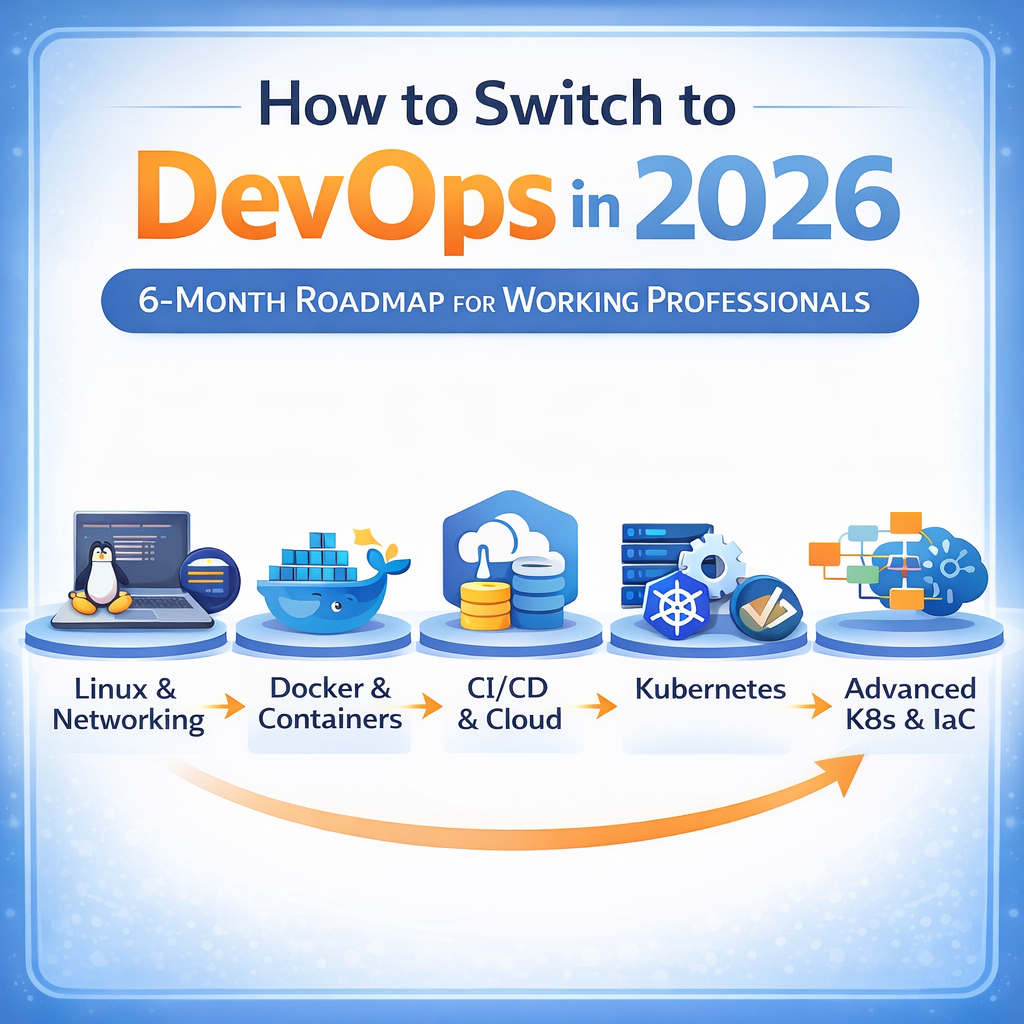
TL;DR: The 6-Month DevOps Pivot (2026 Quick Plan)
Month 1 → Linux + Networking + Git fundamentals
Month 2 → Docker + Containerized real project
Month 3 → CI/CD + Cloud basics + FinOps awareness
Month 4 → Kubernetes for production systems
Month 5 → Advanced Kubernetes + GitOps + Infrastructure as Code
Month 6 → Cloud Architecture + Platform Engineering + AIOps
Six months. Structured learning. No resignation required.
DevOps in 2026 is not about tools. It is about ownership, automation, cloud architecture, cost optimization, and system thinking.
Professionals with 2–4 years of experience and real DevOps skills typically earn ₹8–14 LPA in India. Those with 5–8 years and strong Kubernetes plus cloud exposure often move into ₹15–25 LPA. Engineers who master GitOps, Infrastructure as Code, advanced Kubernetes networking, and cloud architecture frequently cross ₹25 LPA.
Salary follows responsibility.
Why QA Engineers, SysAdmins, DBAs & Developers Are Strong DevOps Candidates in 2026
DevOps is a multiplier skill.
Developers eliminate the “works on my machine” problem through containerization and cloud-native deployment.
QA engineers move from testing features to enforcing automated Quality Gates in CI/CD pipelines.
System Administrators already possess deep Linux troubleshooting skills, the exact foundation needed for Infrastructure as Code and Kubernetes internals.
DevOps is no longer entry-level. It is a structured growth path.
The 6-Month DevOps Roadmap for Working Professionals
This roadmap is realistic for professionals working 8–10 hours daily. One to one-and-a-half focused hours per day is enough when structured.
Month 1: Linux, Networking & Git Foundations
Linux fundamentals include processes, permissions, logs, system services, and performance basics.
Networking includes DNS, TCP/IP, ports, load balancers, and traffic flow.
Git must be understood deeply — branching strategies, rebasing, pull requests, and CI triggers.
Strong foundations reduce long-term confusion.
Month 2: Docker & Containerization (Ending “Works on My Machine”)
Docker packages applications and dependencies into portable containers that run consistently across environments.
Learn Dockerfiles, images, volumes, networking, and Docker Compose.
Build a multi-service application.
Persona Edge – Developers: This is where you permanently solve environment inconsistency and gain deployment confidence.
Month 3: CI/CD, Cloud & FinOps Awareness
Continuous Integration and Continuous Deployment automate builds, testing, and releases.
Use GitHub Actions or GitLab CI to build pipelines that create Docker images and deploy automatically.
Cloud fundamentals are mandatory in 2026. Learn compute, networking, IAM, storage, and scaling basics on AWS, GCP, or Azure.
Add FinOps thinking. Understand cloud cost optimization, right-sizing instances, and scaling trade-offs. Companies in 2026 expect engineers to build systems that run efficiently, not just reliably.
Persona Edge – QA to DevOps Roadmap 2026: Containerize your automated test suites and integrate them into pipelines as Quality Gates. This prevents bad code from reaching production.
Month 4: Kubernetes for Production Systems
Kubernetes orchestrates containers at scale. It manages scaling, rolling updates, service discovery, and self-healing.
Learn Pods, Deployments, Services, ConfigMaps, Secrets, Ingress, and resource limits.
Troubleshooting is critical: crash loops, networking failures, scaling issues.
Kubernetes is effectively mandatory for DevOps engineers in 2026 because most cloud-native applications rely on it.
Month 5: Advanced Kubernetes, GitOps & Infrastructure as Code
Deepen Kubernetes networking. While Ingress is widely used, the ecosystem is evolving toward Gateway API for more flexible traffic management. Understand service discovery, DNS resolution, and network policies.
Explore policy tools like Kyverno to enforce governance rules.
Adopt GitOps using tools like ArgoCD. Git becomes the single source of truth for cluster state.
Learn Infrastructure as Code using Terraform or Crossplane. Treat cloud infrastructure as versioned code.
Add structured FinOps practices, monitoring cluster resource usage and optimizing cloud spend.
Persona Edge – Moving from SysAdmin to Infrastructure as Code: Use your Linux troubleshooting depth to master Terraform or Crossplane. Treat your entire infrastructure like a version-controlled system.
This is also where Platform Engineering begins. Senior engineers design Internal Developer Platforms (IDPs) that simplify deployments for development teams.
Month 6: Cloud Architecture, Platform Engineering & AIOps
Senior DevOps roles in 2026 demand architectural awareness.
Learn scalable cloud design: stateless vs stateful services, caching strategies, database scaling, high availability, and disaster recovery.
Add AIOps (AI-Powered Operations). Modern teams use AI tools for log analysis, anomaly detection, automated root-cause suggestions, and self-healing pipelines.
Platform Engineering becomes the natural evolution of DevOps. Instead of only deploying systems, you design reusable internal platforms for developers.
Senior engineers design systems that are scalable, observable, secure, and cost-efficient.
Why Most IT Professionals Fail Their DevOps Transition (and How to Avoid It)
Jumping to Kubernetes without foundations. Relying only on certifications. Ignoring cloud cost optimization. Avoiding Infrastructure as Code. Trying to learn everything at once. Quitting before validating skills.
DevOps rewards structured depth.
Frequently Asked Questions (2026 SEO Snippet Section)
Can a manual tester switch to DevOps in 2026?
Yes. By learning CI/CD, containerization, and cloud fundamentals, manual testers can transition into automation-driven DevOps roles.
Is Kubernetes mandatory for DevOps engineers in 2026?
In most cloud-native environments, yes. Kubernetes is central to modern application orchestration.
What is the average DevOps salary in India for 5+ years experience?
Professionals with 5+ years experience and strong Kubernetes plus cloud expertise typically earn between ₹15–25 LPA, with advanced roles exceeding that range.
How long does it take to switch to DevOps while working full time?
With structured consistency, six months builds solid foundations. Nine to twelve months builds production confidence.
Final Thoughts
The 11:47 PM moment is real.
The difference between frustration and growth is structure.
Switching to DevOps without quitting your job is possible, if you build Linux depth, containerization skills, CI/CD automation, cloud exposure, Kubernetes maturity, GitOps discipline, Infrastructure as Code expertise, cost awareness, and architectural thinking.
If you want a structured 6-month transformation covering Linux, Docker, CI/CD, Cloud, Kubernetes, GitOps, Infrastructure as Code, Platform Engineering concepts, and System Design, explore our detailed career transition guide:
DevOps Career Transition 2026
https://codekerdos.in/devops-career-transition-2026
Your growth will not come from watching.
It will come from building.
Start building today.