Searching is the process of finding a specific element in a dataset.
- Linear Search → O(n) (checks one by one)
- Binary Search → O(log n) (divides the search space)
Linear search works on any data.
Binary search is much faster—but only works on sorted data.
If performance matters, Binary Search is one of the most powerful algorithms you’ll ever learn.
A Simple Story Before We Start
You open a food delivery app and search for a restaurant.
It shows results instantly.
Now imagine what happens behind the scenes.
There are:
- thousands of restaurants
- millions of users
- real-time filtering
If the system checks every restaurant one by one, it will be slow.
But instead, it uses smarter techniques to narrow down results quickly.
That difference—between checking everything vs narrowing intelligently—is the difference between:
👉 Linear Search
and
👉 Binary Search
What is Searching in DSA?
Searching means finding a target value inside a collection of data.
Example:
- Find a number in an array
- Find a user in a database
- Find a product in a catalog
The efficiency of searching depends on how you search, not just what you search.
Linear Search Explained
Linear Search is the simplest method.
You go through each element one by one until you find the target.
Example
int linearSearch(int[] arr, int target){
for(int i = 0; i < arr.length; i++){
if(arr[i] == target){
return i;
}
}
return -1;
}
How it Works
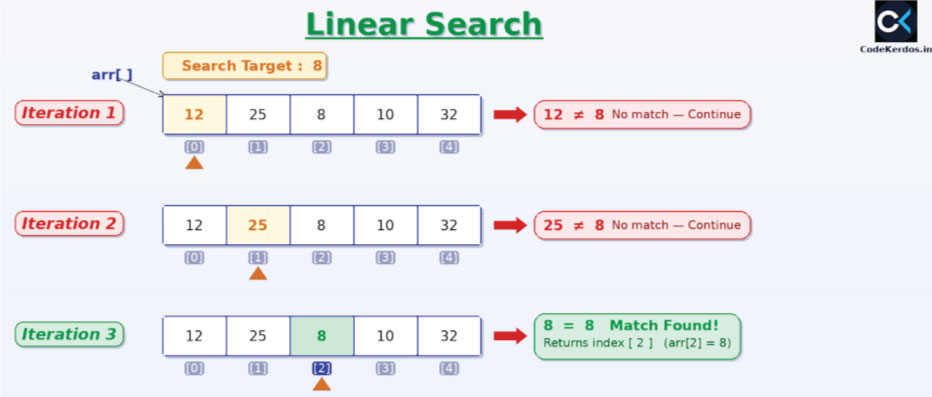
- Start from index 0
- Compare each element
- Stop when found
- Best case → O(1) (found at first position)
- Worst case → O(n) (check all elements)
When to Use Linear Search
- Data is small
- Data is unsorted
- Simplicity matters
Binary Search Explained
Binary Search is much more efficient.
But it requires one condition:
-> The array must be sorted
Example
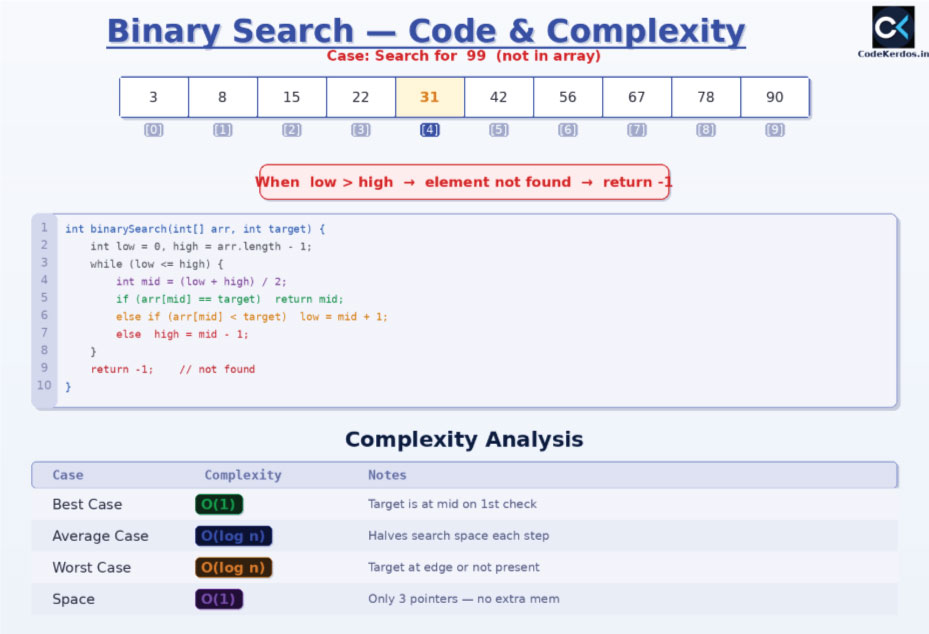
int binarySearch(int[] arr, int target){
int left = 0;
int right = arr.length – 1;
while(left <= right){
int mid = (left + right) / 2;
if(arr[mid] == target) return mid;
else if(arr[mid] < target) left = mid + 1;
else right = mid – 1;
}
return -1;
}
How It Works
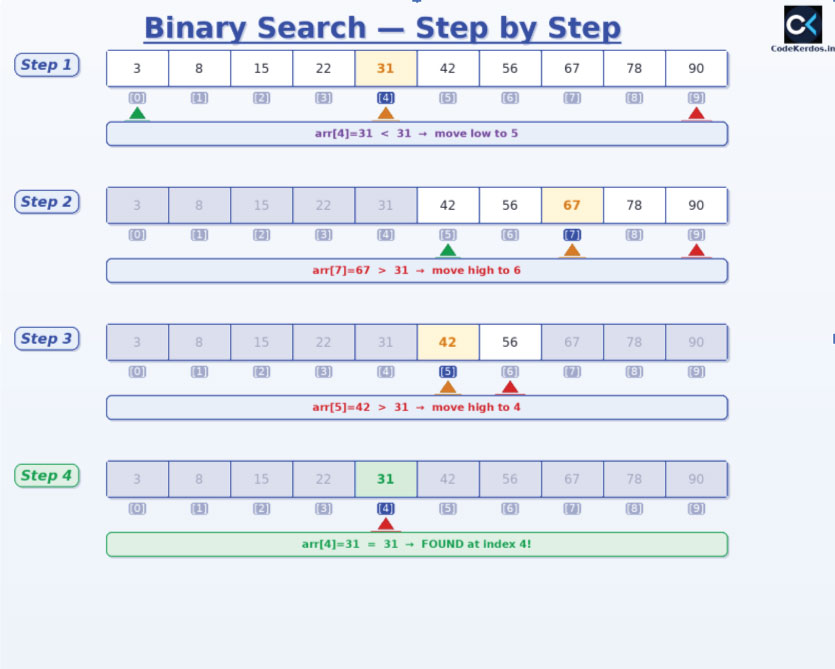
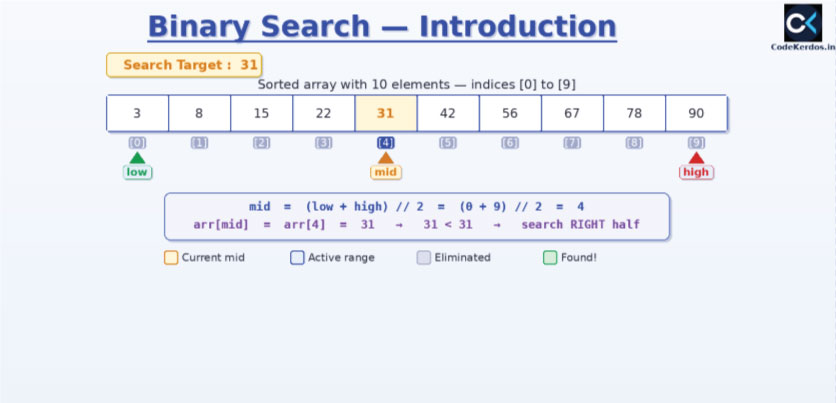
- Check the middle element
- If target is smaller → go left
- If target is larger → go right
- Repeat until found
Each step cuts the search space in half.
Time Complexity
- Best case → O(1)
- Worst case → O(log n)
This is why Binary Search is extremely powerful.
Linear Search vs Binary Search
| Feature | Linear Search | Binary Search |
|---|---|---|
| Data requirement | Unsorted allowed | Must be sorted |
| Time complexity | O(n) | O(log n) |
| Speed | Slow for large data | Very fast |
| Implementation | Simple | Slightly complex |
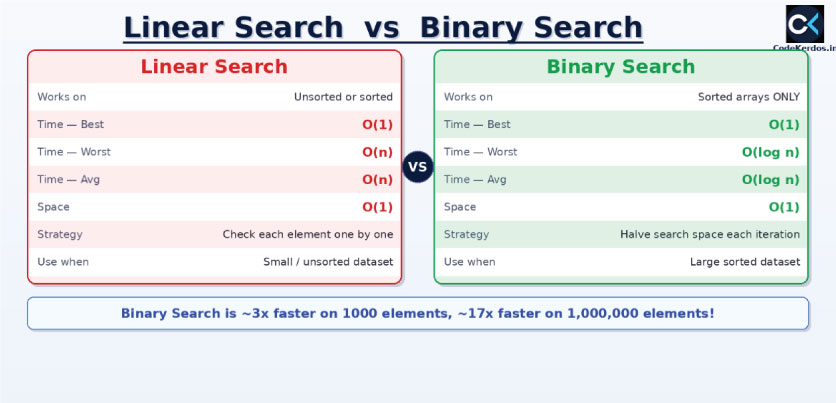
- Linear → scans everything
- Binary → eliminates half every step
Real-World Use Cases
Searching algorithms are used everywhere.
1. Databases
Finding a record quickly among millions of entries.
2. Search Engines
Efficient lookup among billions of pages.
3. E-commerce Platforms
Searching products by name, price, or category.
4. System Design
Efficient searching reduces latency and improves user experience.
Why Binary Search Feels Like Magic
Let’s compare:
- 1,000,000 elements
- Linear Search → up to 1,000,000 checks
- Binary Search → ~20 checks
That’s the power of logarithmic growth.
Common Mistakes Beginners Make
1. Using Binary Search on unsorted arrays
It will give incorrect results.
2. Incorrect mid calculation
Better practice:
int mid = left + (right – left) / 2;
Avoid overflowing in large inputs.
3. Infinite loops
Wrong conditions can cause loops to never end.
A Simple Rule to Remember
- Small data → Linear Search is fine
- Large sorted data → Always use Binary Search
Most advanced problems are built on top of arrays.
If you master arrays, you build a strong foundation for everything that comes next.
Frequently Asked Questions (FAQ)
Only if the data is sorted.
No, because random access is required.
Because it reduces search space exponentially.
No. It is useful when data is small or unsorted.
Final Thoughts
Searching is one of the most fundamental operations in computing.
The difference between Linear Search and Binary Search shows a deeper truth:
The way you approach a problem matters more than the problem itself.
Efficient thinking leads to scalable systems.
And Binary Search is one of the first steps toward that mindset.