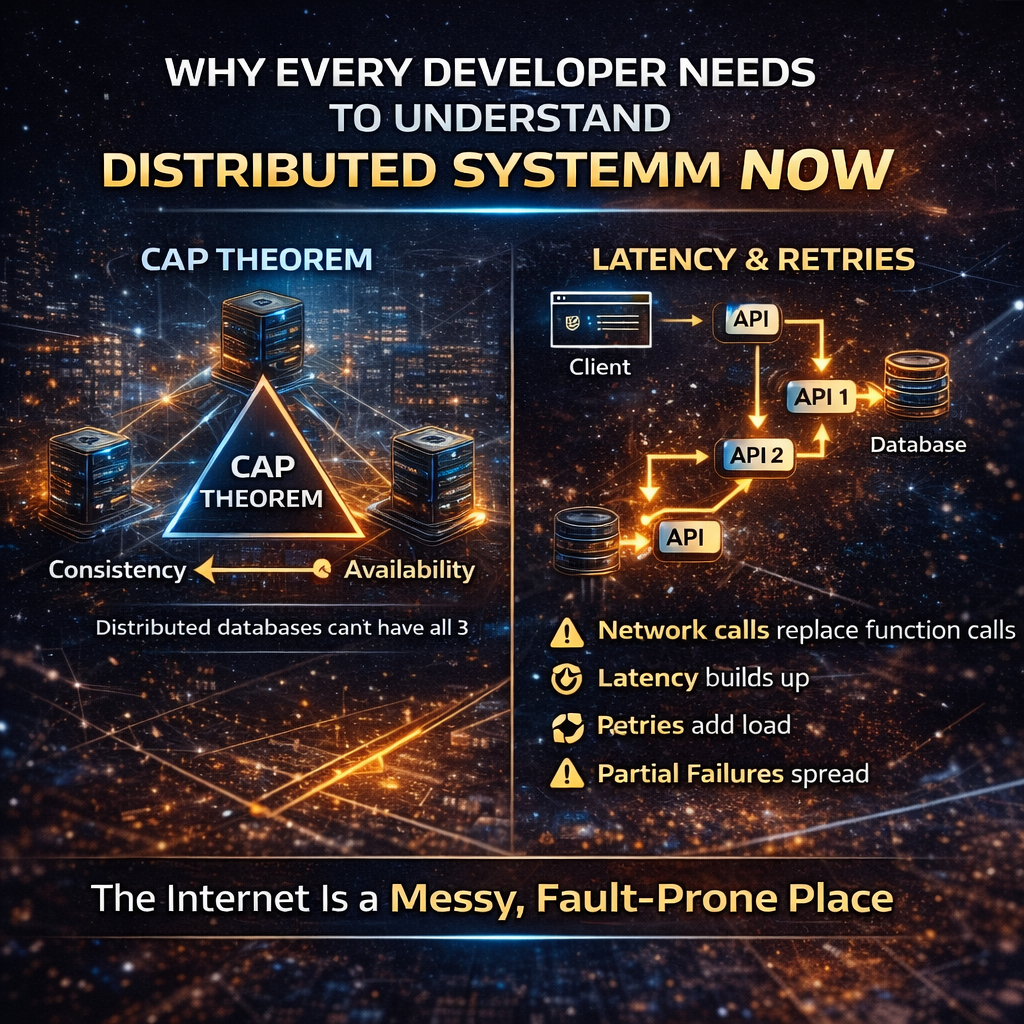
Introduction: Distributed Systems Are No Longer Optional
There was a time when distributed systems were considered an advanced topic, something only backend architects or Big Tech engineers needed to worry about. Most developers could comfortably build applications without ever thinking about network latency, partial failures, or consistency models.
That time is over.
Today, every application is distributed by default.
If you are building:
- A web app using cloud hosting
- A mobile app calling APIs
- A backend using microservices or serverless
- An app using third-party APIs, payment gateways, or authentication services
You are already working in a distributed system, whether you realize it or not.
Understanding distributed systems is no longer a “nice-to-have” skill — it is a core competency for modern developers.
What Is a Distributed System (In Simple Terms)
A distributed system is a system where:
- Multiple components run on different machines
- These components communicate over a network
- Failures are independent and unpredictable
Examples you use every day:
- Web + API server
- Frontend calling multiple backend services
- Database hosted on a different server
- Cloud services like AWS, GCP, Vercel, Firebase
The moment your system crosses a network boundary, it becomes distributed.
Why Distributed Systems Are Everywhere Today
1. Cloud-Native Architecture
Modern applications are built on cloud platforms where:
- Servers are ephemeral
- Instances scale up and down
- Infrastructure is abstracted
You rarely control a single machine anymore.
2. Microservices and Serverless
Even small teams now use:
- Multiple services
- Functions as a Service
- Managed databases
Each service call is a network call, not a function call.
3. Third-Party Dependencies
Modern apps depend heavily on:
- Payment gateways
- Authentication providers
- Email, SMS, notifications
Every dependency introduces distributed failure points.
The Core Problem of Distributed Systems
In a local application:
- Code either works or crashes
In a distributed system:
- The network can fail
- Requests can timeout
- Responses can arrive late or out of order
- Services can partially fail
This uncertainty is the fundamental challenge.
CAP Theorem (Simplified for Developers)
The CAP theorem states that a distributed system can only guarantee two out of three properties at the same time:
Consistency (C)
Every read returns the latest write. All users see the same data at the same time.
Example:
- Bank balance updates instantly everywhere
Availability (A)
Every request receives a response, even if some nodes are down.
Example:
- The system always responds, even during failures
Partition Tolerance (P)
The system continues to function even if network communication breaks between nodes.
Example:
- Data centers lose connectivity but system keeps running
The Key Insight
Network partitions will happen.
So in practice, systems choose between:
- Consistency
- Availability
This choice affects:
- API behavior
- User experience
- Data correctness
Real-World CAP Tradeoffs
Banking Systems
- Prefer Consistency
- Incorrect balances are unacceptable
- Temporary unavailability is tolerated
Social Media Feeds
- Prefer Availability
- Slightly stale data is acceptable
- System must stay responsive
Latency: The Invisible Performance Killer
Latency is the time it takes for a request to travel across the network.
In distributed systems:
- Network latency dominates execution time
- Multiple service hops add up quickly
A single API call may involve:
- API Gateway
- Authentication service
- Business logic service
- Database
Each hop adds milliseconds.
Why Latency Matters Now More Than Ever
Users today expect:
- Instant responses
- Smooth interfaces
- Real-time updates
Even small latency increases:
- Reduce engagement
- Increase bounce rates
- Break user trust
Performance is no longer optional.
Retries: The Double-Edged Sword
Retries are used when requests fail.
While retries improve reliability, they can:
- Amplify traffic
- Cause cascading failures
- Overload downstream services
Uncontrolled retries can bring down entire systems.
Failures Are Normal in Distributed Systems
In distributed systems:
- Machines crash
- Networks drop packets
- Services restart
Failures are expected, not exceptional.
Good systems are designed to:
- Degrade gracefully
- Isolate failures
- Recover automatically
Real-World Impact on APIs
API Timeouts
An API that waits too long:
- Blocks resources
- Reduces throughput
Timeouts must be chosen carefully.
Partial Failures
Some services may succeed while others fail.
APIs must handle:
- Incomplete responses
- Fallback behavior
- Error propagation
Idempotency
APIs must handle repeated requests safely.
This is critical when:
- Retries occur
- Network failures cause duplicate calls
How Distributed Thinking Changes Development
Developers start thinking about:
- Timeouts instead of infinite waits
- Fallbacks instead of assumptions
- Monitoring instead of blind trust
This mindset shift separates coders from engineers.
You Are Already a Distributed Systems Engineer
If you:
- Call APIs
- Use cloud services
- Handle failures
- Care about performance
You are already dealing with distributed systems.
Understanding the fundamentals simply helps you:
- Debug faster
- Design better APIs
- Build resilient systems
What Developers Should Learn First
Start with:
- Network basics
- Latency and timeouts
- CAP theorem intuition
- Failure modes
Then move to:
- Caching
- Message queues
- Event-driven systems
Final Thoughts
Distributed systems are not a specialization anymore. They are the default reality of modern software.
The sooner developers understand this, the fewer production bugs they create — and the better systems they build.
Understanding distributed systems is not about complexity.
It is about respecting reality.