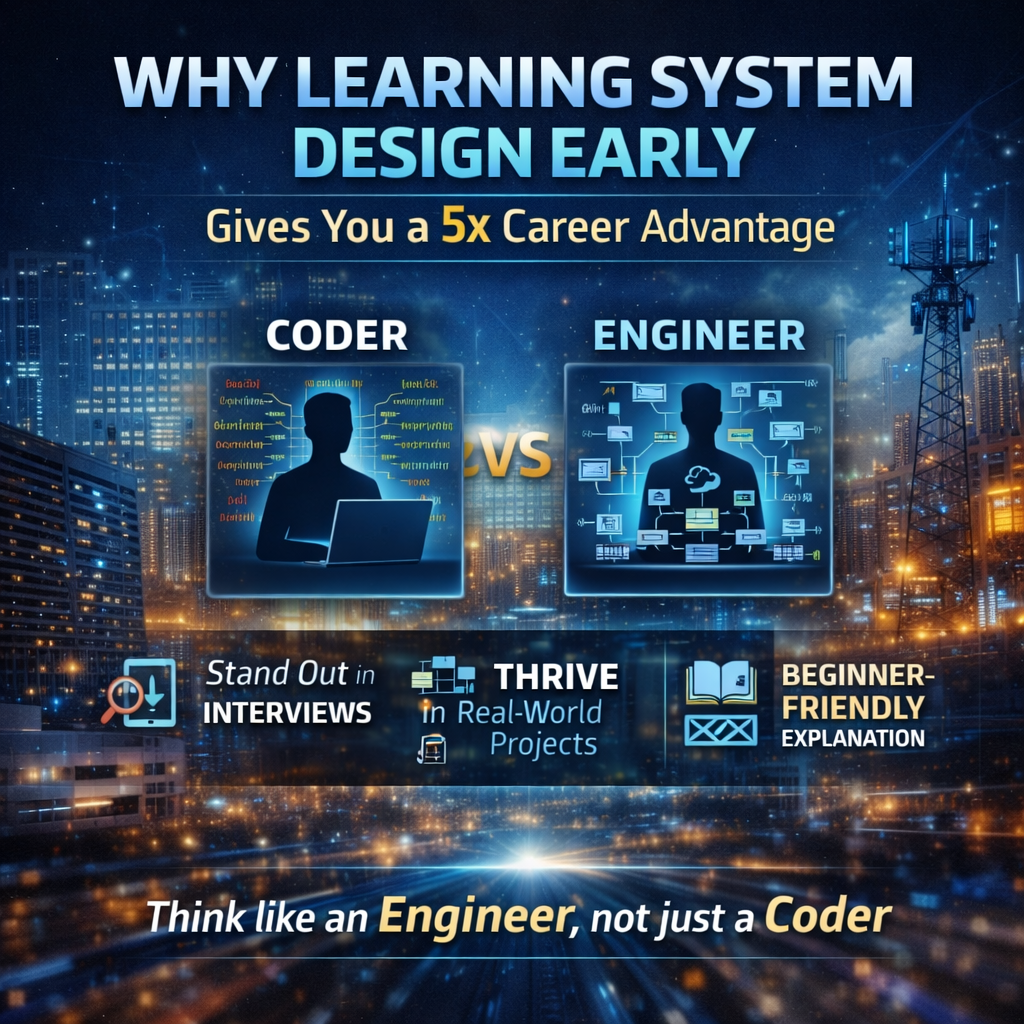
System Design is often treated as an advanced topic—something to learn after years of coding.
That mindset is wrong.
In today’s tech industry, learning system design early doesn’t just make you better at interviews—it fundamentally changes how you think, build, and grow as an engineer.
This blog explains why starting early gives you a 5x career advantage, even if you’re a beginner.
Coder vs Engineer: The Real Difference
Most people start as coders.
Very few consciously become engineers.
A Coder Thinks:
- How do I write this function?
- Which syntax should I use?
- How do I complete this task?
An Engineer Thinks:
- How will this system scale?
- What happens if users grow 10x?
- Where can this fail?
- How do components communicate?
Coding is about lines of code.
Engineering is about systems that survive real-world usage.
System design is what bridges this gap.
What Is System Design (Beginner-Friendly)
System design is the art of structuring software systems so they are:
- Scalable
- Reliable
- Maintainable
- Efficient
It answers questions like:
- Where does data live?
- How do services talk to each other?
- How do we handle millions of users?
- What breaks first under load?
You don’t need to know everything.
You need to understand how pieces fit together.
Why Learning System Design Early Matters
I You Stop Writing Fragile Code
Beginners often write code that:
- Works locally
- Breaks in production
- Can’t handle load
Early system design teaches you to:
- Think stateless
- Handle failures gracefully
- Separate responsibilities
Your code becomes production-aware, not tutorial-bound.
II You Build Real-World Thinking Early
Tutorials show:
“Build a to-do app”
System design asks:
- What if 1M users use it?
- Where do tasks get stored?
- How do we prevent data loss?
This mindset prepares you for actual industry problems, not just assignments.
III Massive Interview Advantage (5x Factor)
Most candidates:
- Can solve DSA
- Can explain syntax
Few can:
- Design a scalable system
- Explain trade-offs
- Think at architecture level
Interviewers remember candidates who:
- Ask the right questions
- Think holistically
- Justify decisions
System design instantly places you in the top bracket.
System Design in Interviews vs Real World
In Interviews:
- Design WhatsApp / Instagram / URL shortener
- Explain load balancing
- Talk about databases & caching
In Real Projects:
- Designing APIs
- Handling concurrency
- Avoiding single points of failure
- Planning for growth
The same principles apply—just different scale.
Beginners Think: “It’s Too Early for Me”
Reality:
You don’t need:
- Complex distributed systems
- Advanced cloud knowledge
You DO need:
- Basic client-server understanding
- Request–response lifecycle
- Database vs cache concept
- Stateless vs stateful services
These concepts are beginner-friendly if taught right.
What Happens If You Learn System Design Late
Common pattern:
- Years of coding
- Suddenly asked to scale
- Panic, rewrites, hacks
Late learners struggle to:
- Unlearn bad practices
- Shift mindset
- Think beyond functions
Early learners grow naturally into senior roles.
How System Design Shapes Your Career Growth
Junior Level
- Write better structured code
- Understand backend flow
Mid Level
- Design modules & services
- Handle performance issues
Senior Level
- Own architecture
- Make scalability decisions
- Mentor teams
System design accelerates every stage.
Real Example: Login Feature
Coder Approach:
- Create API
- Save user
- Return response
Engineer Approach:
- Authentication vs authorization
- Token management
- Rate limiting
- Security concerns
- Scalability of auth service
Same feature. Completely different depth.
How to Start Learning System Design Early
Start small:
- How a request reaches server
- How data flows
- Where bottlenecks appear
Then grow into:
- Load balancing
- Caching
- Database design
- Horizontal scaling
System design is a journey, not a chapter.
Tools Don’t Matter, Thinking Does
Languages change.
Frameworks evolve.
System thinking stays.
That’s why:
System design skill ages slower than any tech stack.
Final Thoughts
Learning system design early doesn’t make things harder.
It makes everything else easier.
You:
- Write better code
- Crack better interviews
- Build production-ready systems
- Grow faster than peers
That’s the 5x career advantage.
Start thinking in systems today, and your future self will thank you.