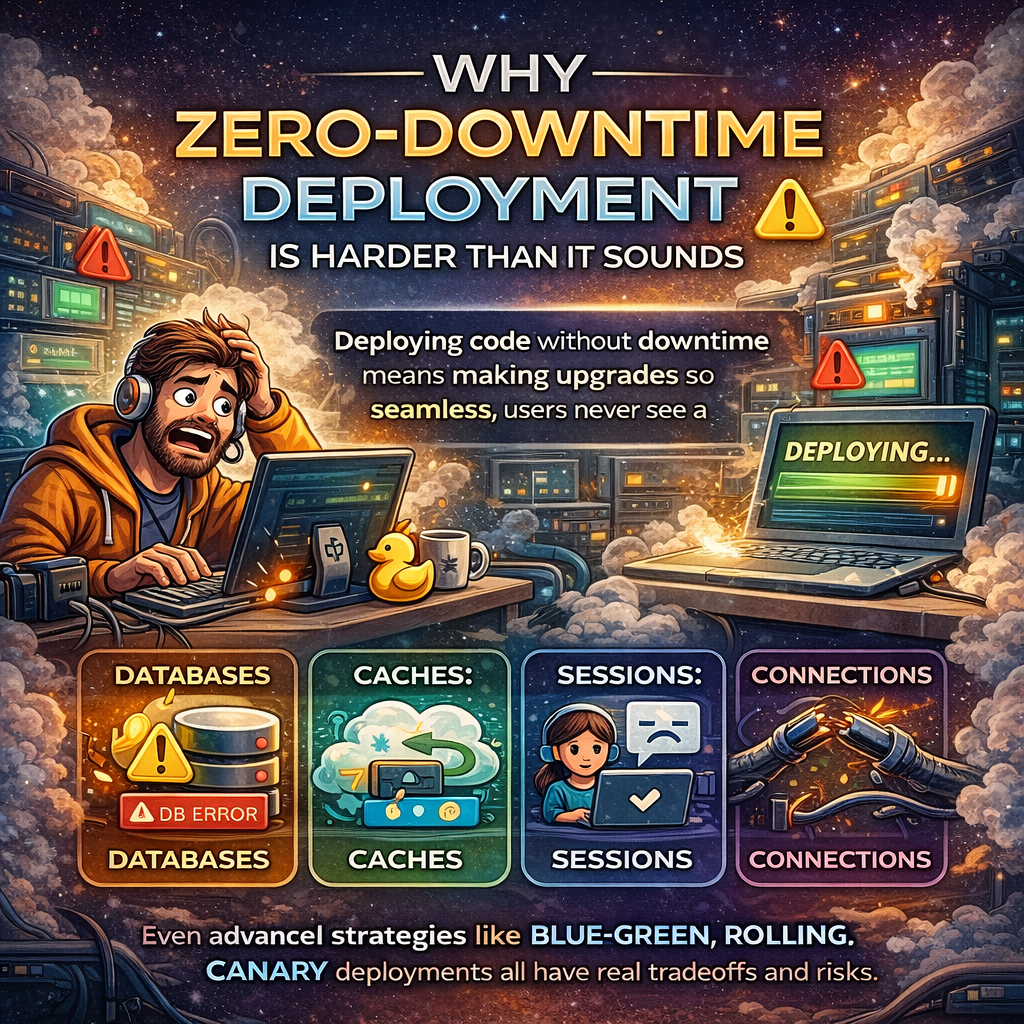
Zero-downtime deployment sounds like a simple promise: deploy new code without interrupting users. In reality, it is one of the hardest problems in modern DevOps and system design. Many teams believe that using containers, cloud, or CI/CD automatically guarantees zero downtime, until their first production incident proves otherwise.
This blog explains why zero-downtime deployment is genuinely difficult, how real systems approach it, and what usually goes wrong.
1. What Zero-Downtime Deployment Actually Means
Zero-downtime deployment does not mean:
- No servers restarting
- No latency spikes
- No internal errors
It means:
- Users should not experience failures
- Requests should continue to succeed
- No broken sessions, lost data, or corrupted state
From a system perspective, this requires old and new versions of code to coexist safely.
2. Why “Just Restart the Server” Fails
In early systems, deployments were simple:
- Stop the server
- Replace code
- Start the server again
This works only when:
- Traffic is low
- No real-time users exist
- Sessions are not important
Modern systems break this assumption:
- Millions of concurrent users
- Long-lived connections (WebSockets, streaming)
- Stateful authentication tokens
- Distributed caches
A restart instantly drops requests and connections.
3. The Core Challenge: Running Two Versions at Once
The hardest part of zero-downtime deployment is compatibility.
During deployment:
- Some users hit old code
- Some users hit new code
- Both talk to the same database, cache, and queues
If the two versions are not compatible, things break silently.
Common compatibility problems:
- New code expects new DB fields
- Old code crashes on new schema
- Cache keys change format
- API responses change shape
This is where most teams fail.
4. Database Changes: The Silent Downtime Creator
Databases are the most dangerous part of deployments.
Example failure:
- New code adds a
NOT NULLcolumn - Old code still writes records
- Writes start failing
- Users see errors even though servers are running
Safe database migration requires:
- Backward-compatible schema changes
- Multiple deployment phases
- Data backfills
This is slow, careful, and error-prone.
5. Load Balancers Are Not Magic
Many believe load balancers automatically ensure zero downtime.
In reality, they only:
- Route traffic
- Detect unhealthy instances
They do not know:
- If your app is ready
- If in-flight requests are safe
- If shutdown will break sessions
Without graceful shutdown logic, instances die mid-request.
6. Long-Lived Connections Make It Worse
Applications using:
- WebSockets
- Streaming APIs
- Server-Sent Events
Cannot simply rotate servers.
If a server restarts:
- Connections drop
- Users must reconnect
- State may be lost
Zero downtime here often requires:
- Connection draining
- Session migration
- Stateful handoff
Very few systems implement this correctly.
7. Deployment Strategies (And Their Tradeoffs)
Blue-Green Deployment
- Two identical environments
- Switch traffic instantly
Problems:
- Database compatibility still required
- Costly duplicate infrastructure
Rolling Deployment
- Replace servers one by one
Problems:
- Old and new code mix
- Hard to roll back cleanly
Canary Deployment
- Release to small user percentage
Problems:
- Hard to detect subtle bugs
- Monitoring must be excellent
8. Feature Flags: The Real Secret Weapon
Feature flags decouple deployment from release.
Benefits:
- Code can be deployed but inactive
- Instant rollback without redeploy
- Gradual exposure
But misuse causes:
- Permanent dead code
- Complex logic paths
- Debugging nightmares
9. Observability Is Mandatory
Without observability, zero downtime is impossible.
You need:
- Metrics (latency, errors)
- Logs (structured, searchable)
- Traces (request flow across services)
If you cannot see failures, users will.
10. Why Zero-Downtime Is a Cultural Problem
Zero-downtime deployment is not just tooling.
It requires:
- Engineering discipline
- Backward-compatible thinking
- Patience over speed
- Ownership of production behavior
Teams that rush deployments pay later.
11. The Real Truth
Most systems do not achieve true zero downtime.
They aim for:
- Minimal user impact
- Fast recovery
- Controlled failures
This mindset shift is what separates mature DevOps teams from beginners.
Final Thoughts
Zero-downtime deployment is hard because systems are complex, stateful, and interconnected.
Success comes not from tools, but from:
- Design discipline
- Deployment strategy
- Deep understanding of system behavior
This is why DevOps is an engineering responsibility, not just a pipeline.