Sorting algorithms arrange data in a specific order (ascending or descending).
- Bubble Sort → O(n²) (simple but slow)
- Merge Sort → O(n log n) (stable and efficient)
- Quick Sort → O(n log n) (fast in practice)
Sorting is used everywhere from databases to search engines because organized data enables faster operations like searching and filtering.
A Simple Story Before We Start
You open an e-commerce app and search for “shoes.”
Thousands of results appear instantly.
But what makes it useful?
👉 Results are sorted.
- Price: low to high
- Ratings: best first
- Relevance: most accurate
Now imagine if products were shown randomly.
You’d scroll endlessly.
You’d leave the app.
That’s why sorting is not just a feature, it’s a core system requirement.
Behind every sorted list, there’s an algorithm deciding the order efficiently.
What is Sorting in DSA?
Sorting means arranging data in a particular order.
Example:
- Unsorted → [40, 10, 30, 20]
- Sorted → [10, 20, 30, 40]
Sorting makes other operations faster, especially:
- Searching
- Data analysis
- Optimization
Why Sorting Matters
Sorting is critical because:
- Binary Search requires sorted data
- Databases rely on sorted indexes
- Systems process ordered data faster
Without sorting, many algorithms become inefficient.
Bubble Sort Explained
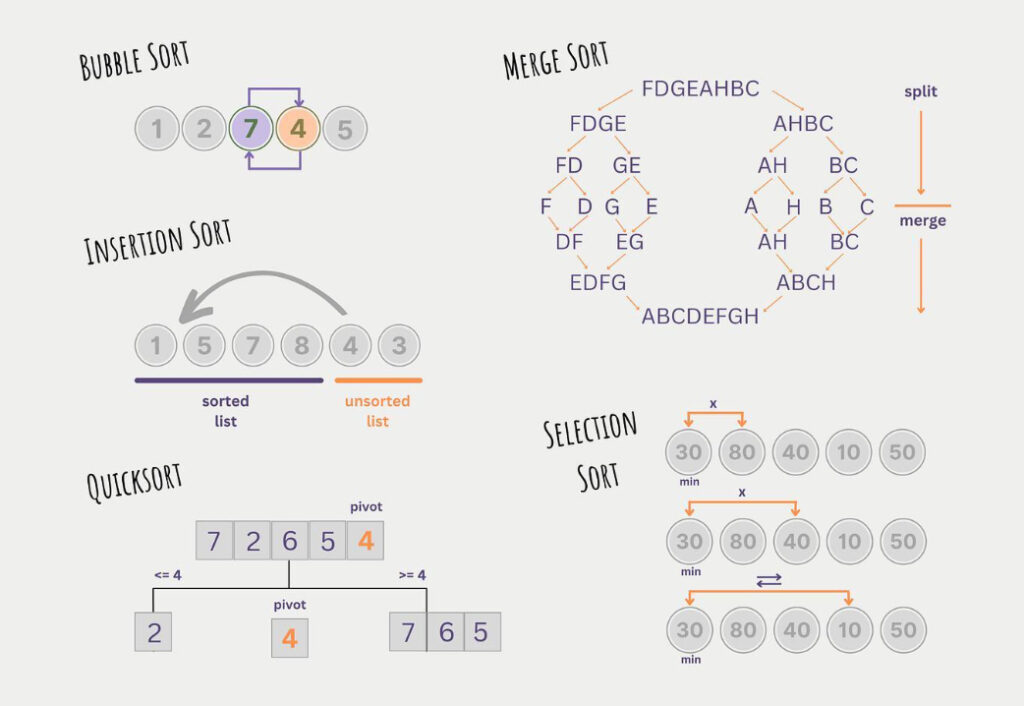
Bubble Sort is the simplest sorting algorithm.
It repeatedly compares adjacent elements and swaps them if they are in the wrong order.
Example Code
void bubbleSort(int[] arr){
int n = arr.length;
for(int i = 0; i < n; i++){
for(int j = 0; j < n – i – 1; j++){
if(arr[j] > arr[j + 1]){
int temp = arr[j];
arr[j] = arr[j + 1];
arr[j + 1] = temp;
}
}
}
}
How It Works
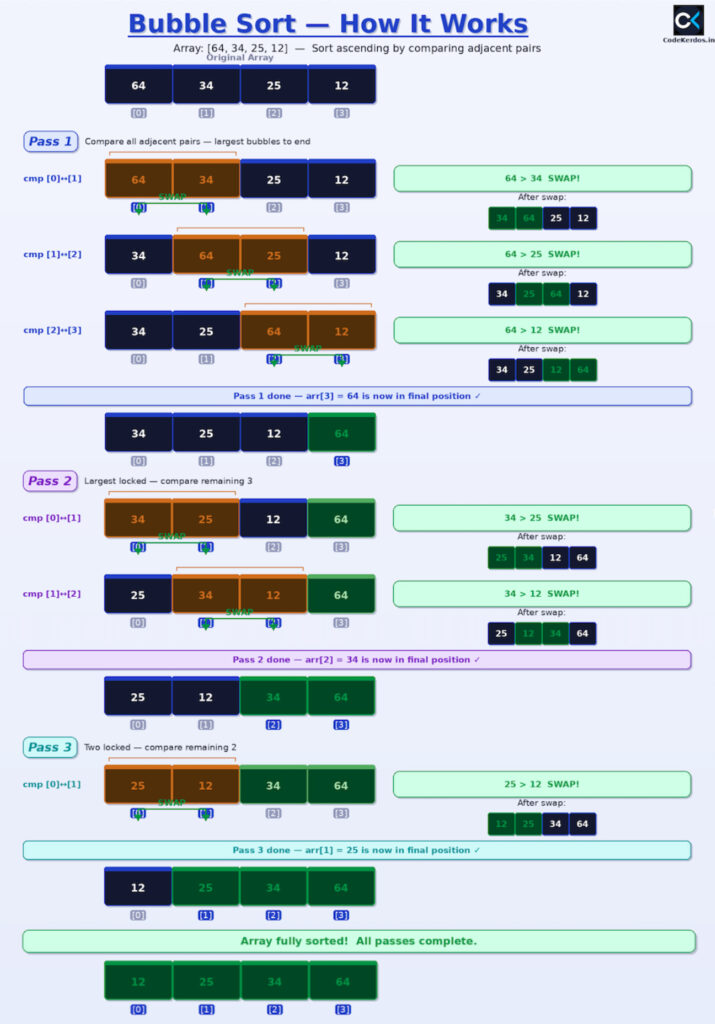
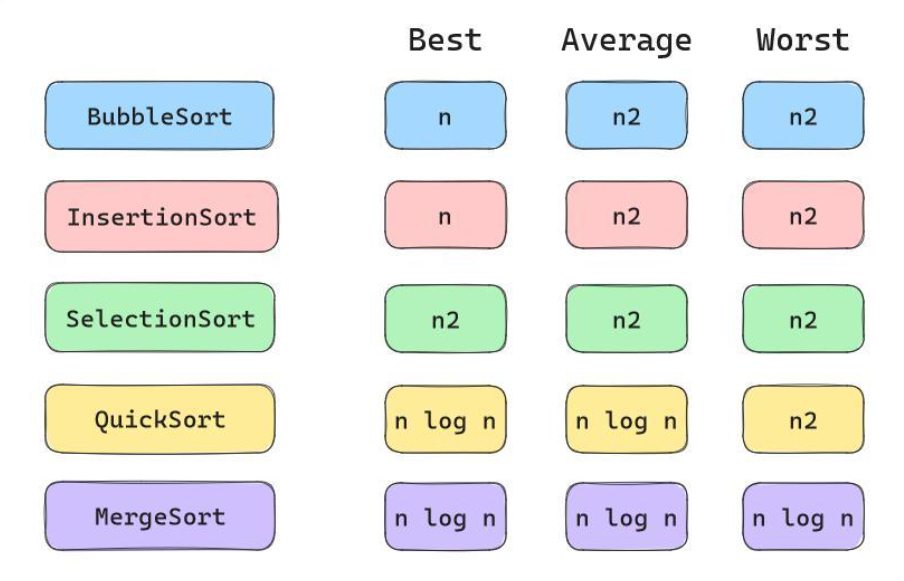
Time Complexity
- Best → O(n)
- Worst → O(n²)
When to Use
- Learning purposes
- Very small datasets
Merge Sort Explained
Merge Sort uses divide and conquer.
It divides the array into smaller parts, sorts them, and merges them back.
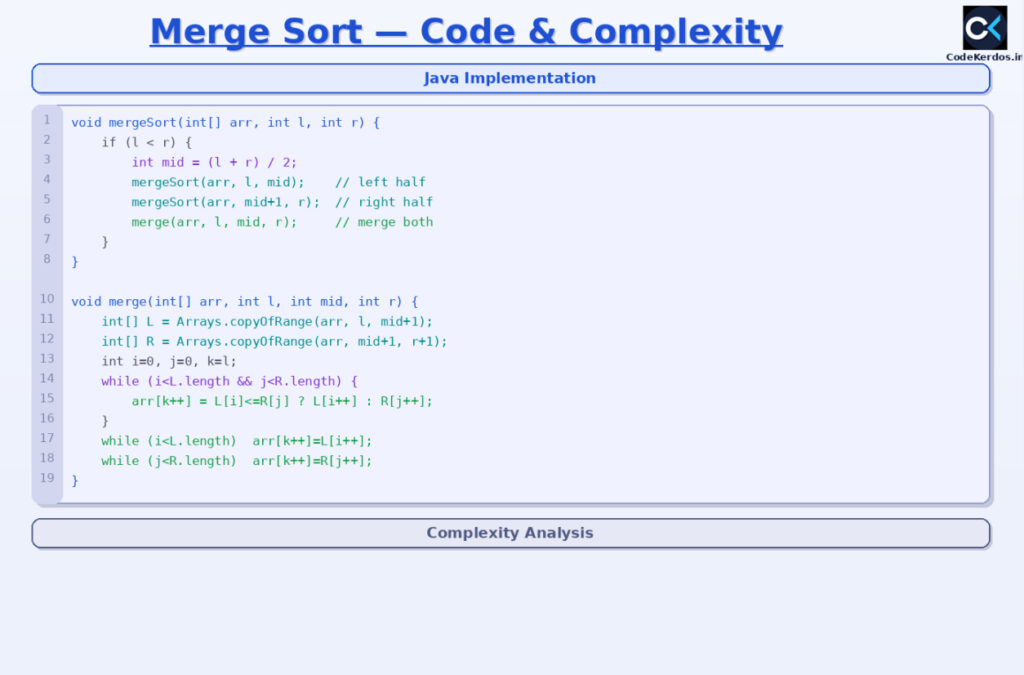
Example Code
void mergeSort(int[] arr, int left, int right){
if(left < right){
int mid = (left + right) / 2;
mergeSort(arr, left, mid);
mergeSort(arr, mid + 1, right);
merge(arr, left, mid, right);
}
}
How It Works
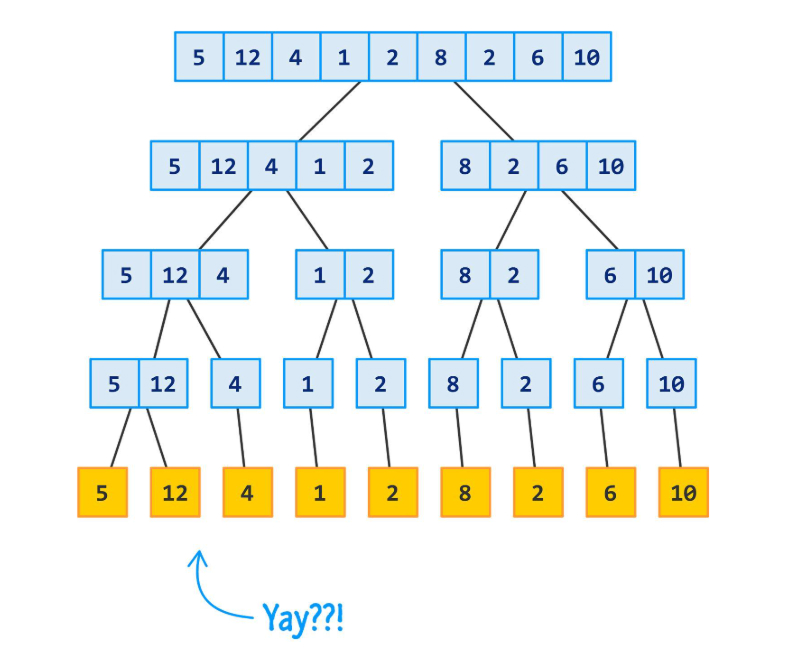
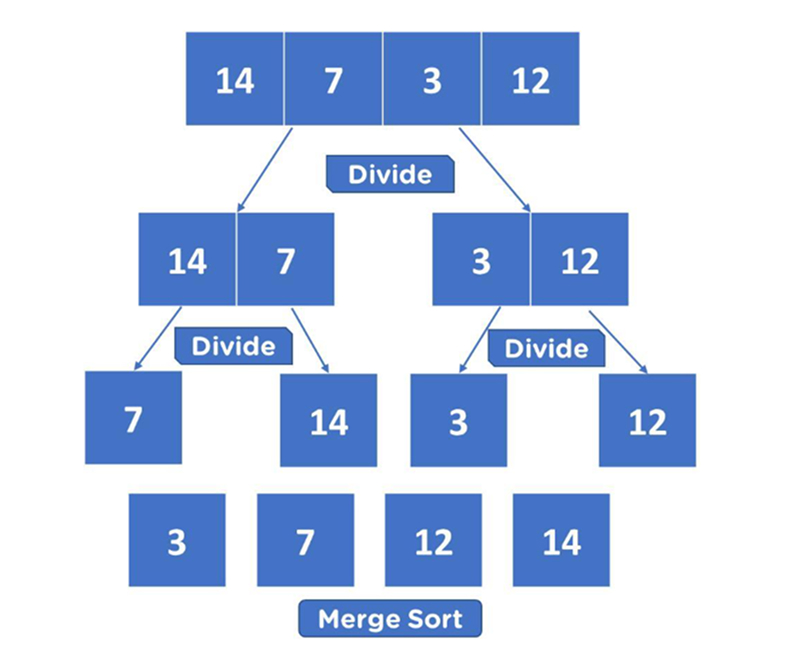
- Divide array into halves
- Sort each half
- Merge them in order
Time Complexity
- Always → O(n log n)
Why It’s Powerful
- Consistent performance
- Stable sorting
- Works well for large data
Quick Sort Explained
Quick Sort is one of the fastest sorting algorithms in practice.
It selects a pivot and partitions the array.
Example Code
int partition(int[] arr, int low, int high){
int pivot = arr[high];
int i = low – 1;
for(int j = low; j < high; j++){
if(arr[j] < pivot){
i++;
int temp = arr[i];
arr[i] = arr[j];
arr[j] = temp;
}
}
int temp = arr[i + 1];
arr[i + 1] = arr[high];
arr[high] = temp;
return i + 1;
}
How It Works
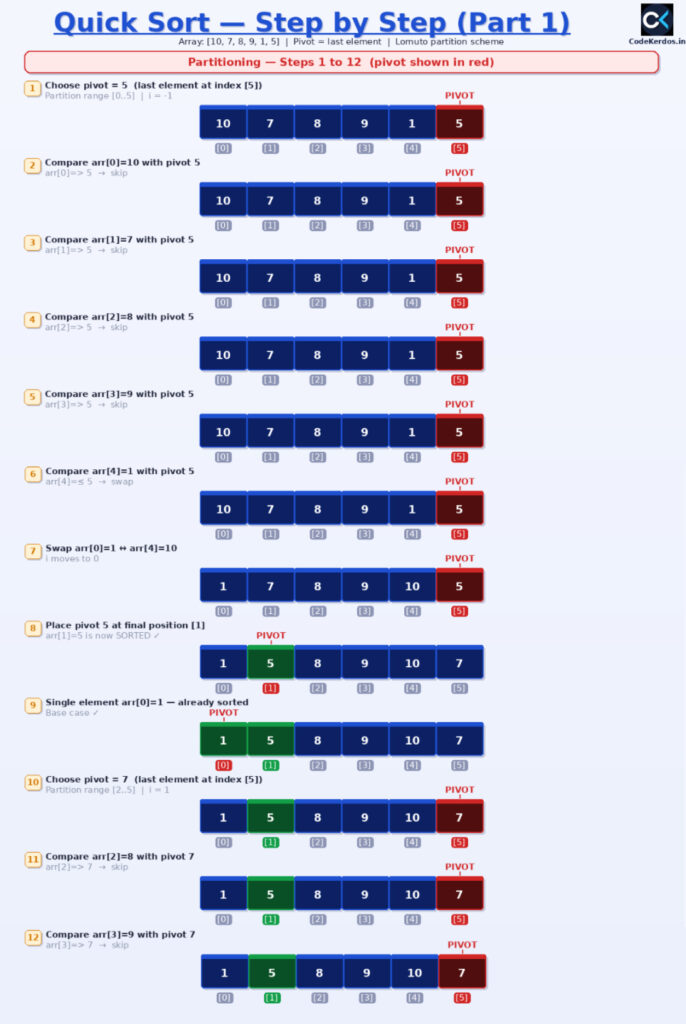
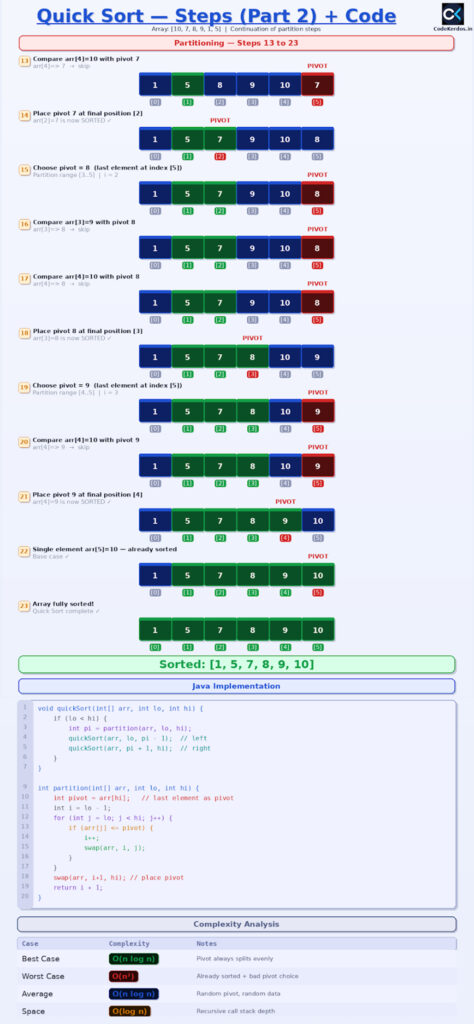
- Choose pivot
- Place smaller elements on left
- Larger elements on right
- Repeat recursively
Time Complexity
- Average → O(n log n)
- Worst → O(n²)
Why It’s Popular
- Fast in real-world applications
- In-place sorting (low memory usage)
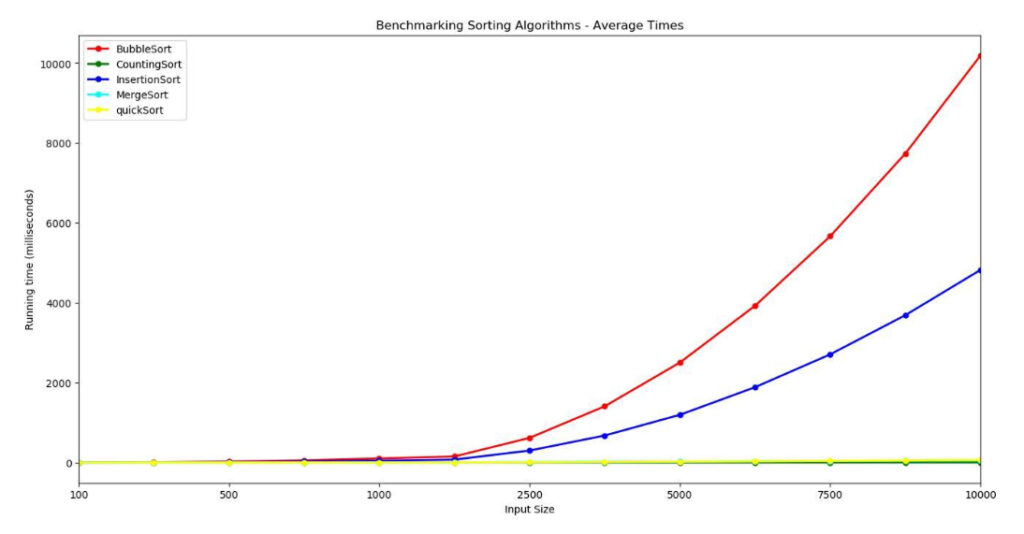
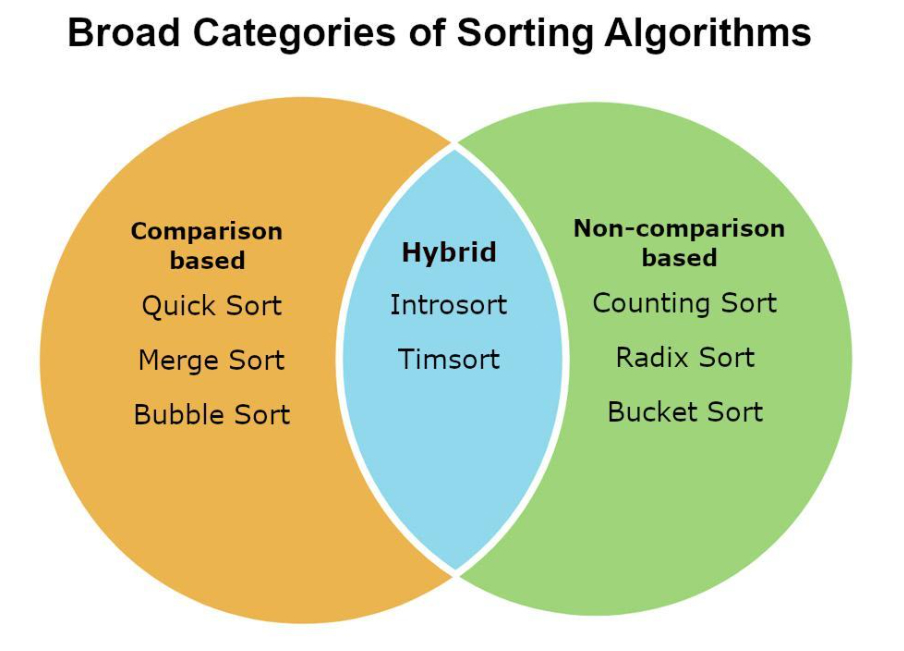
Comparison of Sorting Algorithms
Algorithm | Time Complexity | Space | Use Case |
Bubble Sort | O(n²) | Low | Learning |
Merge Sort | O(n log n) | Extra space | Large data |
Quick Sort | O(n log n) | Low | Fastest practical |
Real-World Use Cases
Sorting is used in:
1. E-commerce
Sort products by price, rating, popularity
2. Databases
Indexing and query optimization
3. Analytics Systems
Ordering large datasets
4. Operating Systems
Scheduling tasks
Common Mistakes Beginners Make
- Using Bubble Sort for large datasets
- Ignoring time complexity
- Not understanding recursion (Merge/Quick)
- Choosing wrong algorithm for problem
A Simple Rule to Remember
- Small data → simple sorting works
- Large data → use efficient algorithms
Frequently Asked Questions (FAQ)
Depends on use case, but Quick Sort and Merge Sort are most efficient.
It helps understand basic sorting logic.
Yes. Almost every system relies on sorting internally.
Sorting that maintains relative order of equal elements.
Final Thoughts
Sorting is not just about arranging numbers.
It is about:
- Improving performance
- Enabling faster searches
- Organizing large-scale data
Efficient sorting transforms raw data into usable information.
And that is why sorting algorithms are a core part of every engineer’s toolkit.