- By Debjyoti Maity | SRE at Improving | DevOps mentor at CodeKerdos
Imagine you’ve been waiting for GTA 6 for years.
You’ve pre-ordered the game, downloaded the files in advance, and finally the launch countdown reaches zero. You grab your controller, open the game, and press Play.
For you, it’s just a button.
But behind that one action, several things may need to happen. The game must be installed correctly. The platform must verify your purchase. The required game files must be available. Authentication and other connected services may need to respond. And if the game collects telemetry, that information needs to reach the backend without slowing down your gameplay.
Now think about the people who made this possible.
Long before launch day, developers were writing code, artists were creating assets, engineers were building and packaging those assets, testers were finding defects, and infrastructure teams were maintaining the systems that supported development.
And that’s not even the complete challenge.
When millions of players want to download and access a game around the same time, the problem shifts from building software to designing systems that can handle enormous demand.
This is where two engineering disciplines become particularly interesting: DevOps and System Design.
Rockstar Games’ official GTA VI credits list dedicated roles across Build Engineering, DevOps, Network Programming, Database Engineering, Security Engineering, Telemetry Engineering, Quality Assurance, and Release Management.
These are not simply developers writing game code. They represent an entire engineering ecosystem working to build, validate, protect, distribute, and support a massive software product.
Let’s explore what happens behind the scenes and what engineers can learn from it.
An important distinction: Rockstar’s credits confirm the specialist engineering roles, but they do not disclose every internal tool, architecture, or implementation. In this article, we’ll separate publicly documented information from general engineering patterns that could be used in a game of this scale.
Part 1: DevOps and the Engineering Required to Build GTA 6
1. Build Engineering: How Do You Build a Game This Large?
Think about everything that goes into an open-world game.
There are buildings, roads, vehicles, characters, textures, animations, audio files, physics systems, gameplay logic, and countless other assets.
Now imagine hundreds of developers and artists working on different parts of the same project.
A developer changes a small component of the game. Should the entire game be rebuilt from scratch just because of that one change?
That would waste considerable time and computing resources.
This is where Build Engineering becomes important.
A build system takes source code, assets, dependencies, and configuration and produces the artifacts required for testing and release.
For a project with a large codebase and asset library, a build pipeline can use techniques such as:
- Incremental builds: Instead of rebuilding everything, only the affected components are rebuilt when possible.
- Build caching: Previously generated outputs can be reused when their inputs and dependencies have not changed.
- Parallel compilation: Independent build tasks can run simultaneously across available computing resources.
Consider a simple example.
Suppose the team modifies the handling behaviour of a vehicle. If the change affects only a particular module, the build system should avoid unnecessarily rebuilding unrelated components.
The build process still needs to track dependencies carefully. If one component depends on another that has changed, its output may also need to be regenerated.
Rockstar’s official credits list a dedicated Build Engineering section as well as Build & Release Engineers. This gives us a direct indication of how important this specialist function is to the project.
However, the exact build tools and caching implementation Rockstar uses have not been publicly established.
2. CI/CD: A Successful Build Doesn’t Mean a Working Game
Let’s continue with our vehicle example.
A developer changes the physics of a car. The code compiles successfully. The build completes without errors.
Does that mean the change is ready?
Not necessarily.
The vehicle might accelerate incorrectly, behave differently during a collision, or respond unexpectedly on different road surfaces.
A successful compilation only tells us that the build process completed. It doesn’t prove that the game behaves correctly.
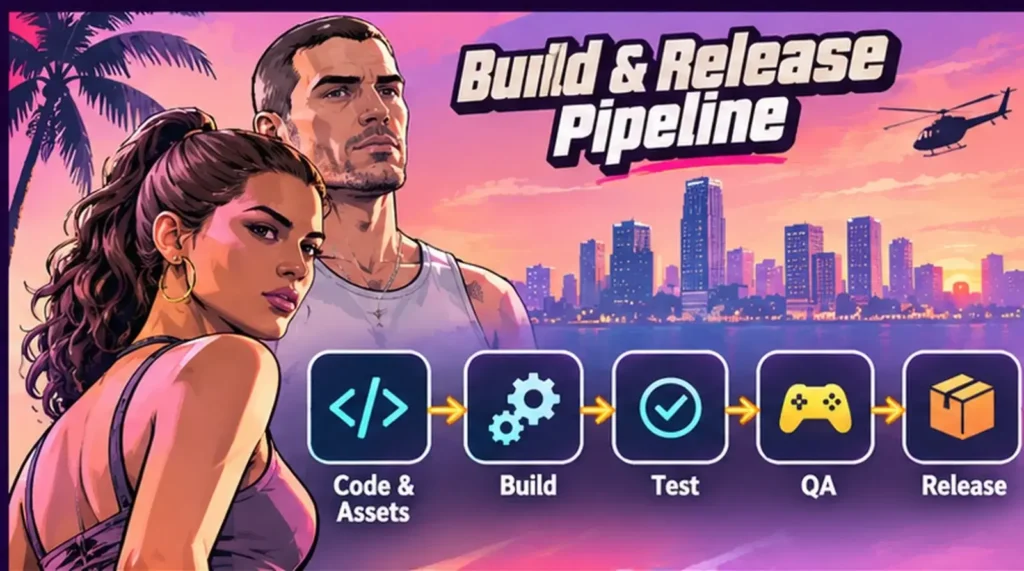
This is where Continuous Integration and automated testing become important.
A game-development validation pipeline might include:
- Code validation and automated tests.
- Integration testing across related game systems.
- Regression testing to identify previously working features that have broken.
- Performance testing to detect CPU, GPU, and memory regressions.
- Compatibility testing across target hardware.
- Manual gameplay and quality assurance testing.
Game builds are different from a typical web application deployment.
You cannot simply build a container, push it to a registry, and deploy every commit to millions of players.
Game releases involve versioned packages, extensive QA, release candidates, platform-specific requirements, and distribution processes.
Automated build and testing pipelines can help teams identify problems much earlier, but physical hardware testing and human quality assurance still matter.
For example, console development kits and automated test environments can be used for different validation activities. We should not assume that one generic console simulator can reproduce every real-world hardware and gameplay condition.
The larger lesson is simple:
Build automation helps create the game. CI and testing help establish whether the game is ready. Release engineering helps get the right version to players.
3. Infrastructure Engineering: A Game Doesn’t Need to Be SaaS to Need Infrastructure
Here’s an interesting question.
GTA 6 is a game, not a conventional SaaS application. So why would it require a substantial infrastructure and operations team?
Because development itself requires enormous computing resources.
Think about the different people working on the project.
An artist creating a detailed environment needs powerful graphics workstations. A developer compiling a large codebase needs reliable build infrastructure. A team working on animations may need access to large shared assets.
All these people depend on internal engineering systems.
The infrastructure might include:
- High-performance developer workstations.
- Build servers and distributed compute capacity.
- Source code and asset storage.
- Shared development environments.
- High-speed internal networking.
- Backup and recovery systems.
- Test environments and development tooling.
Imagine a developer waiting 40 minutes for every build because the build infrastructure is overloaded.
Now imagine that happening across hundreds of engineers.
That becomes a productivity problem, not just a technical inconvenience.
Infrastructure Engineering ensures that developers, artists, build systems, and testing teams have the computing, storage, and connectivity required to do their work.
This is an important DevOps lesson: Infrastructure engineering is not limited to running public-facing applications. The internal systems used to build software also need to be reliable.
4. Security Engineering: Protecting More Than Production Servers
A game that has taken years to develop contains valuable intellectual property.
Unreleased story content, source code, character models, artwork, development assets, and internal tools all need protection.
Imagine an attacker getting access to an internal source repository or an unreleased game build.
That could create enormous commercial and reputational damage.
Security Engineering therefore needs to protect the complete development environment.
This includes:
- Identity and access management: Developers should only receive access to the repositories, environments, and services they need.
- Repository security: Source code and sensitive development assets must be protected.
- Build pipeline security: Build credentials, signing keys, dependencies, and artifacts need appropriate controls.
- Monitoring: Suspicious access patterns and unusual activity should be investigated.
- Supply-chain security: Dependencies and build artifacts should be validated to reduce the risk of compromised components.
Rockstar’s credits include a dedicated Security Engineering function. They also list separate DevOps and infrastructure operations roles, demonstrating that these are specialized responsibilities rather than one generic job.
5. Database and Network Engineering: Supporting the Entire Development Ecosystem
A large game-development project generates and consumes a significant amount of information.
Think about build metadata, test results, development records, asset information, user access, and information supporting connected services.
Databases are needed to store and retrieve different categories of information.
Not every dataset has the same requirements.
For example, a build system needs to retrieve information about the correct build artifacts and dependencies. A purchase-entitlement system needs to determine whether a user has the right to access purchased content.
Those are different data problems.
Networking is equally important.
GTA VI is not being developed by a single person working on one computer. Teams across studios need to exchange source code, large assets, builds, and development information.
Imagine a team waiting for several gigabytes of environment assets to synchronize before it can continue working.
Network bandwidth, connectivity, storage performance, and data transfer bottlenecks can directly affect engineering productivity.
This is why large software projects need dedicated network engineering and systems operations.
The official credits list Network Programming, Network Operations, Linux Operations, Windows Operations, and Database Engineering roles.
Together, these roles demonstrate something important: modern software development depends on an entire ecosystem of engineering capabilities.
Part 2: System Design and the Challenge of Launching a Global Game
Building the game is only one side of the challenge.
Let’s switch perspectives.
The game is ready. The release date has arrived. Players want to download it, verify ownership, launch it, and start playing.
Now we have a different problem.
How do we design the systems that support this experience when demand increases dramatically within a short period?
This is a classic System Design problem.
6. The Launch-Day Problem: What Happens When Millions of Players Download at Once?
Suppose a major game becomes available worldwide.
People in different countries are waiting for the same release time. Some have already purchased it, while others are purchasing it when it becomes available.
A large proportion of players may start downloading around the same time.
This creates a traffic spike.
The problem is not simply how much data needs to be delivered. It is when that demand arrives.
Consider an illustrative capacity-planning exercise.
Let’s assume:
- 10 million players download the game.
- The download package is 200 GB.
- All 10 million players download it within 24 hours.
The total data transferred would be:
10,000,000 x 200 GB = 2,000,000,000 GB = 2 EB
That’s approximately 2 exabytes of data.
Across 24 hours, this represents an average delivery rate of approximately:
(2 EB x 8) / (24 x 3600) ≈ 185.2 Tbps
Now suppose half of that total download volume arrives within the first four hours.
The average delivery rate during that window would be approximately 555 Tbps.
These are illustrative decimal-unit calculations, not GTA VI’s actual download size, player count, or measured launch traffic. They also represent aggregate delivery demand, not the throughput required from a single origin server.
But the exercise shows why launch-day capacity planning is different from ordinary daily traffic.
A system may comfortably handle a large number of downloads throughout the day and still struggle when a substantial portion of that demand arrives within minutes.
7. CDN and Edge Caching: Delivering Game Files Closer to Players
Let’s start with the most obvious problem: downloading the game.
Should every player download the entire game directly from one central server?
No.
That would create unnecessary pressure on the origin infrastructure and introduce additional network latency.
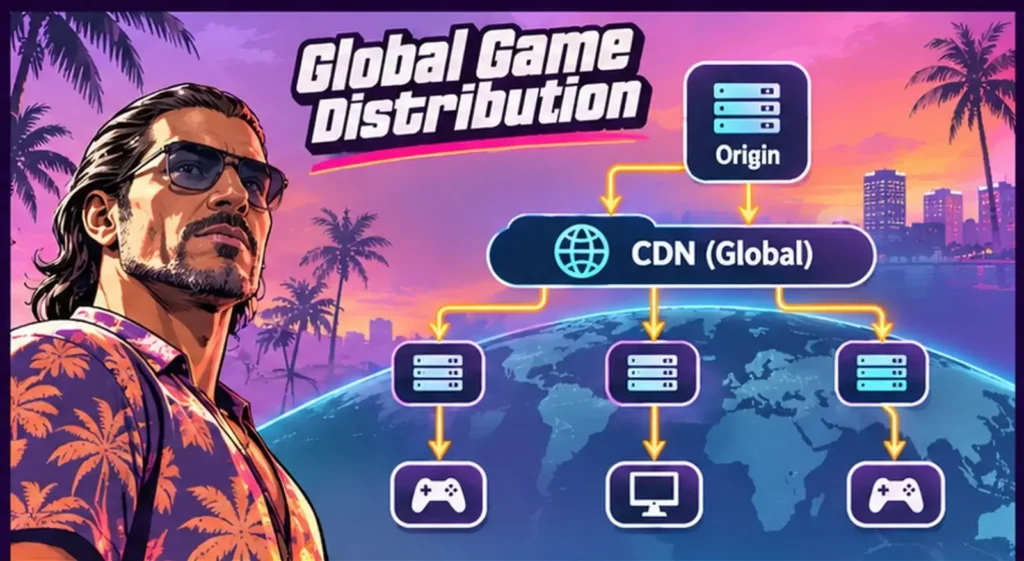
This is why Content Delivery Networks, or CDNs, are so important.
A CDN distributes copies of content across geographically distributed servers called Points of Presence (PoPs).
Instead of retrieving a file from a distant origin every time, users can often download it from a nearby cache.
For example, imagine a player in India downloading a game.
A suitable CDN setup may serve the content from a regional or ISP-connected cache instead of requiring every request to travel back to a distant origin.
This is called edge caching.
Some CDN providers also partner with Internet Service Providers to place caches within or close to ISP networks. This can reduce the distance data travels and help avoid unnecessary upstream network hops.
The important idea is that the content should be available as close as practical to the people downloading it.
What if one CDN becomes unavailable?
Now let’s introduce another failure scenario.
Suppose an application depends heavily on one CDN provider. That provider experiences a regional outage or performance degradation.
Downloads may become slower or fail.
One architectural approach is Multi-CDN steering.
Instead of depending on a single content delivery provider, the distribution system can make decisions based on:
- Player location.
- CDN availability.
- Network latency.
- Download performance.
- Error rates.
- Regional capacity.
A routing or steering service can direct requests towards an appropriate CDN.
Some download systems can also use resumable, chunk-based transfers. With the necessary client and content-version support, different chunks may be fetched from different providers.
The objective is to avoid a single delivery provider becoming a bottleneck for the entire release.
However, multiple CDNs introduce additional complexity. Content consistency, cache invalidation, versioning, monitoring, and failover behaviour must all be designed carefully.
We should not assume Rockstar uses a particular Multi-CDN architecture. This is a common design pattern for large-scale content delivery.
8. Throttling, Pre-Downloads, and Load Shifting
Can we solve the launch traffic problem simply by adding more servers?
Not always.
Infrastructure capacity is expensive, and massive short-lived spikes can still overwhelm systems if demand is not controlled.
This is where traffic management comes in.
There are three useful concepts.
Throttling
Instead of allowing unlimited requests, the system limits how much traffic or how many requests it accepts during a given period.
For example, a service might temporarily limit download initiation requests to protect its backend services.
The goal is controlled degradation rather than total failure.
Load shifting
Instead of allowing everyone to download at the exact same moment, demand can be distributed over a longer period.
Pre-downloads are a common example.
Players download the game before launch, but the game remains locked until the official release time.
This allows content delivery to happen earlier, reducing the amount of traffic concentrated at launch.
Staggered releases
A release can also be scheduled across regions or time zones where the business and platform arrangements allow it.
This can smooth the traffic curve, although it introduces its own challenges around entitlement, regional availability, and release coordination.
Another useful technique is modular or partial downloading.
Imagine the game allows players to download the essential components first, while optional content is downloaded later.
The game can potentially become playable before every optional asset is available.
This requires careful dependency management. The initial package must contain everything needed for the enabled gameplay path.
These are general release-engineering patterns, not claims that GTA VI implements each of them.
9. Purchase Verification, Login, and Database Consistency
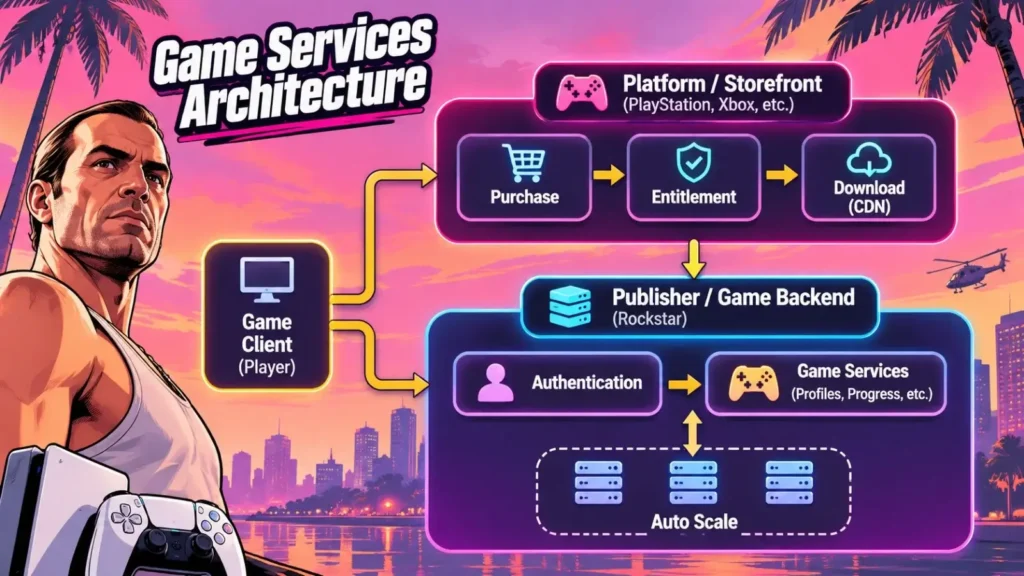
(Illustrative architecture only. This shows a possible separation between platform services and publisher-operated game services, not Rockstar’s confirmed internal architecture)
Downloading the game is not the end of the journey.
You install it, open it, and try to launch it.
The system may need to verify that you own the game.
This is called entitlement verification.
An entitlement system determines whether a user has permission to access a particular digital product or service.
A digital storefront, such as PlayStation Store or Xbox Store, has its own purchase and content-delivery responsibilities. The game publisher may also operate separate account and game services.
These systems should not be treated as one giant application.
For example, a simplified player journey could look like this:
- The player purchases the game through a storefront.
- The game package is downloaded.
- The platform verifies the player’s entitlement.
- Required authentication or publisher services are contacted.
- The game launches.
- Optional services such as telemetry and analytics operate alongside the game.
The exact flow and responsibilities depend on the platform and game implementation. This is a conceptual example, not a confirmed diagram of GTA VI’s backend.
Now consider what happens if the purchase-verification service becomes unavailable.
You own the game, but the system cannot verify your entitlement.
Should the game launch?
That depends on the platform’s licensing and offline-access policies. The important engineering problem is that a critical dependency can prevent the entire user journey from progressing.
There is a useful real-world example from PlayStation.
At the Game Developers Conference, Sony Interactive Entertainment and Google Cloud presented the migration of PlayStation’s global entitlement system to Google Cloud Spanner. The system supports access verification across a platform with more than 350 million user accounts. The presentation describes a 10x reduction in storage, a 50% reduction in costs, and zero downtime during the migration.
This is a PlayStation platform example, not evidence that GTA VI uses Spanner.
Why is this interesting?
Because entitlement data has different requirements from ordinary content delivery.
A CDN can serve a cached copy of a game file to millions of users.
But deciding whether a particular account owns a particular game requires the correct user and entitlement information.
Database design therefore depends on data access patterns and consistency requirements.
Some information can tolerate a small delay before appearing in every read path. This is the idea behind eventual consistency.
But ownership, payment, and access-control decisions often require stronger correctness guarantees.
A database architecture must reflect those requirements. There is no universal rule that SQL is always better than NoSQL, or vice versa.
The right design depends on how data is accessed, updated, replicated, and validated.
One more distinction is worth remembering:
- QPS: Queries per second.
- TPS: Transactions per second.
- Concurrency: The number of operations in progress at the same time.
These measurements are related, but they are not interchangeable. An engineer must understand what the system is actually measuring before estimating capacity.
10. Retry Storms, Queues, and Preventing Cascading Failures
Imagine the login service becomes overloaded.
A player tries to log in. The request fails.
The client immediately retries.
Thousands of other players do exactly the same thing.
Now the server is receiving the original traffic plus a large number of additional retry requests.
The system becomes even more overloaded.
This is called a retry storm.
Instead of helping the system recover, uncontrolled retries can make the failure worse.
There are several techniques to prevent this.
Exponential backoff
Increase the waiting period between retries.
For example:
- First retry: 2 seconds.
- Second retry: 4 seconds.
- Third retry: 8 seconds.
The exact values depend on the application, but the idea is to reduce repeated requests while the service recovers.
Jitter
Add a small random delay to retry intervals.
Without jitter, thousands of clients may retry at exactly the same time. That creates another spike.
Jitter spreads the retry attempts over a wider interval.
Retry-After
A server can return a Retry-After response header to tell clients when to try again. Clients must actually respect that instruction.
Rate limiting and circuit breakers
Rate limiting controls how much traffic a service accepts.
A circuit breaker can temporarily stop requests to an unhealthy dependency, giving it time to recover and preventing repeated failures from spreading through the system.
There is another useful technique: queues.
Instead of processing every incoming request immediately, a service can accept work and place it into a queue for later processing.
This allows the system to absorb temporary bursts.
But queues are not unlimited storage. They need capacity limits, monitoring, retention policies, and backpressure. If incoming work continuously exceeds processing capacity, the queue will eventually fill.
A small System Design exercise: What happens when traffic exceeds capacity?
Suppose a database-backed service can process 10,000 requests per second under a simplified set of assumptions.
Now imagine it receives 15,000 requests per second for ten seconds.
If the system processes 10,000 requests each second, the remaining 5,000 requests accumulate in a queue.
After ten seconds, the backlog could reach 50,000 requests.
If new traffic then stops and the service can continue processing 10,000 requests per second, it would need about five seconds to drain that backlog.
This assumes that processing capacity remains available and that the queue has enough space.
We can also use Little’s Law to reason about concurrency:
L = λ x W
Where:
- (L) is the average number of requests in the system.
- (λ) is the average arrival rate.
- (W) is the average time a request spends in the system.
For example, 100 concurrent processing slots with a 10 ms average service time suggest a theoretical capacity of approximately 10,000 operations per second, assuming each slot handles one operation at a time without additional overhead.
This is a simplified estimate, not a guaranteed database benchmark.
The lesson is that system design isn’t just about adding servers. It is about controlling how work enters, moves through, and leaves the system.
11. Telemetry: How Do You Learn What Millions of Players Are Experiencing?
Here’s another interesting part of modern gaming.
A player downloads a game and starts playing. For the player, the experience is simply gameplay.
But the engineering team may need to understand:
- Which hardware configurations are experiencing crashes?
- Are loading times increasing in certain regions?
- Which game areas have performance problems?
- Are users experiencing unexpected errors?
- Are particular updates causing regressions?
This is where telemetry becomes important.
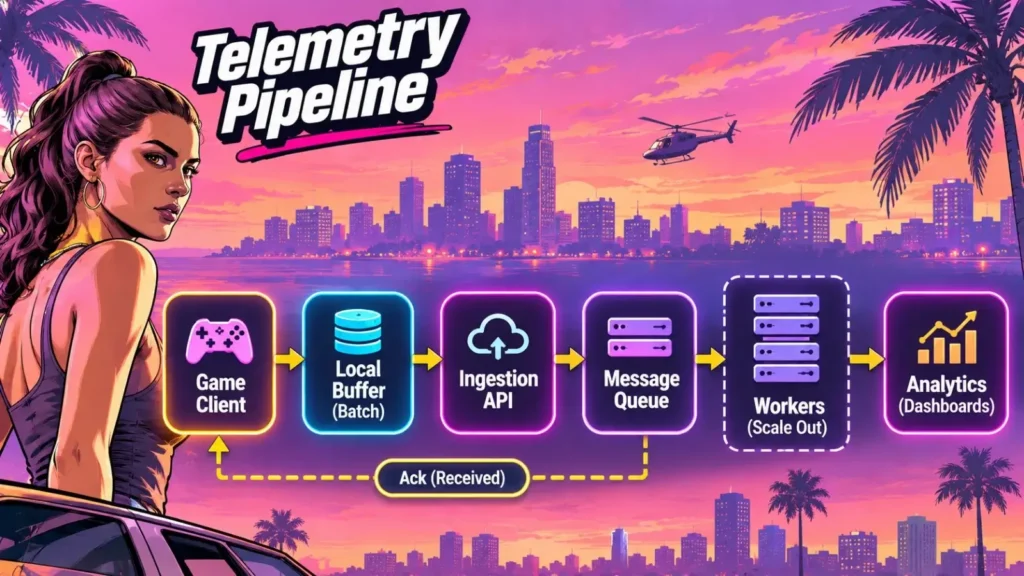
(The ingestion API acknowledges the batch after it has been durably accepted by the messaging system. The diagram shows a simplified acknowledgment path)
Telemetry is the collection and transmission of operational or application data that helps engineers understand how a system behaves.
However, imagine sending a separate server request for every single gameplay event.
That would create enormous request overhead.
A better approach for suitable telemetry workloads is batching.
The game client can collect selected events locally and send them to the backend periodically as a batch.
Step 1: Collect events.
The client records selected performance, crash, or gameplay events. A bounded local buffer can temporarily hold the information.
Step 2: Send batches.
Instead of sending thousands of individual requests, the client periodically groups events and sends them together.
Step 3: Acknowledge receipt.
The ingestion service validates the batch and places it into durable storage or a messaging system before acknowledging successful acceptance.
Step 4: Process asynchronously.
Workers consume messages independently and process the events.
Step 5: Scale workers.
If the backlog grows, more workers can be added, subject to downstream capacity.
Technologies such as Kafka and RabbitMQ are examples of messaging systems that can support this kind of architecture.
The advantage is that the client doesn’t need to wait for the entire analytics pipeline to finish processing its data.
The telemetry system can work independently.
This also introduces an important reliability principle: telemetry should generally be a soft dependency for gameplay. If analytics is temporarily unavailable, the game should not automatically stop working. Local buffering, controlled loss of noncritical events, and retry policies can help.
Of course, what is collected, how long it is retained, and how it is used must also follow appropriate privacy and security requirements.
Rockstar’s official GTA VI credits include a dedicated Telemetry Engineering function. That confirms the specialist role exists, although the credits don’t disclose the exact telemetry pipeline.
12. Patching and Configuration: A Game Is Never Just One Release
Let’s say a game launches successfully.
Millions of players start exploring the world.
Soon, engineers discover a problem that wasn’t reproduced during pre-release testing.
Perhaps a particular configuration produces crashes, or a gameplay system needs adjustment.
How can the development team fix it?
There are two different situations.
Configuration changes and server-side controls
Some behaviours can be controlled through configuration values or feature flags designed into the application.
A team might disable a feature, adjust a value, or change a server-side behaviour without rebuilding the entire client.
These changes are useful, but only when the game architecture supports them.
Client-side patches
If the actual game binary or bundled content needs modification, a patch is generally required.
That involves creating a new build, validating it, packaging it, and distributing it through the relevant platform.
The distinction is important.
A configuration change may be relatively quick. A client update has a larger release and distribution process.
There is also a lesson here from live engineering: release management must consider compatibility between different client versions and backend services.
A new patch should not unexpectedly break users who are still running an older supported version.
What Can DevOps and System Design Engineers Learn From GTA 6?
After looking at both sides of the engineering challenge, several important lessons emerge.
| Engineering lesson | What it teaches us |
|---|---|
| Build Engineering | Large projects need optimized, repeatable build systems |
| CI/CD and testing | Successful compilation does not guarantee working software |
| Infrastructure Engineering | Internal development environments need reliable compute, storage, and networking |
| Security | Protect code, credentials, assets, and release pipelines |
| CDNs and caching | Repeated content should be served efficiently and close to users |
| Traffic management | A short traffic spike can be more dangerous than sustained high demand |
| Database consistency | Data correctness requirements depend on what the data represents |
| Graceful degradation | Noncritical dependencies should not take down the whole experience |
| Queues and backpressure | Separate ingestion from processing and protect downstream systems |
| Telemetry | Real-world data can reveal failures that testing did not catch |
There is a bigger lesson connecting everything.
System Design helps us decide how the different components should interact and how the system should behave under load and failure.
DevOps helps us build, test, package, release, and operate those components reliably.
SRE brings a focus on service reliability, measurable objectives, incident response, and continuous improvement.
These disciplines are complementary.
You might be working on a banking application, an AI platform, a cloud-native product, or a large gaming ecosystem. The underlying engineering challenges often have much in common.
How Can You Start Learning These Engineering Concepts?
You don’t need to work at a gaming company to learn from these problems.
In fact, you can practise most of the concepts using ordinary applications and infrastructure.
For the DevOps side, start by learning Linux, Git, networking, Docker, CI/CD, Kubernetes, cloud infrastructure, infrastructure automation, and observability.
Build a pipeline that compiles an application, runs tests, scans its container image, and deploys it to Kubernetes. Then introduce failures and practise troubleshooting them.
For the System Design side, start with data structures and algorithms, then move into APIs, databases, caching, load balancing, distributed systems, queues, scalability, and reliability.
Take a simple application and ask:
What happens if one million users access it at the same time?
What happens if the database becomes slow?
How can we prevent one failing service from affecting everything else?
How should the system handle retries?
Where should we cache data?
How do we measure whether the system is performing well?
These questions are at the heart of System Design.
At CodeKerdos, we approach these as complementary engineering skills.
Our DevOps & SRE Program focuses on modern infrastructure, automation, CI/CD, Docker, Kubernetes, cloud engineering, monitoring, observability, and reliability practices through hands-on projects.
Our Advance DSA + System Design Program builds problem-solving foundations and progresses into system architecture, APIs, databases, scalability, and real-world design case studies.
The idea is not to memorize tools or architecture diagrams.
It is to understand why systems are designed a certain way, how their components interact, and what happens when something fails.
Because that is what engineering work actually involves.
Final Thoughts
When you play GTA 6, you see the city, the characters, the vehicles, and the incredible amount of detail that went into creating the experience.
You probably don’t think about incremental builds, asset pipelines, database consistency, CDN edge caching, retry strategies, or telemetry ingestion.
And you shouldn’t have to.
That’s the job of the engineers behind the experience.
But for those of us working in DevOps, SRE, infrastructure, and System Design, there is a lot to learn from the engineering problems surrounding a game of this scale.
Building the game is one challenge.
Getting it into the hands of millions of players is another.
Keeping its connected services, updates, and supporting systems reliable is yet another.
The real engineering achievement isn’t just making something that works. It’s designing a system that continues to work when millions of people depend on it at the same time.
And that lesson goes far beyond gaming.
Frequently Asked Questions
Large game-development projects involve build engineering, automated testing, CI/CD, infrastructure management, security, release engineering, database operations, and network engineering. Rockstar’s official GTA VI credits list several of these specialist functions.
Game development requires substantial internal infrastructure for source code, assets, developer workstations, build systems, testing, storage, networking, and release management. These needs exist even when the game itself can be played offline.
A Content Delivery Network distributes game packages and assets through geographically distributed cache locations. This helps reduce latency, distribute download demand, and protect origin infrastructure from excessive traffic.
Multi-CDN architecture uses multiple content delivery providers and selects suitable delivery paths based on factors such as geography, availability, performance, and cost. It can reduce dependency on a single provider.
Queues separate incoming requests from downstream processing. They can absorb temporary traffic bursts, smooth processing demand, and allow workers to scale independently. They still need capacity limits and backpressure to handle sustained overload safely.
Telemetry is the collection of selected data about application behaviour, performance, errors, and user interactions. Engineering teams can analyse it to identify problems, understand performance, and improve later releases.
DevOps focuses on the practices and automation required to build, test, release, and operate software. System Design focuses on how software components, databases, networks, and infrastructure are organized to meet functional and nonfunctional requirements. Both are important for reliable large-scale systems.